Calibration Brief vs Job Description for Design Roles
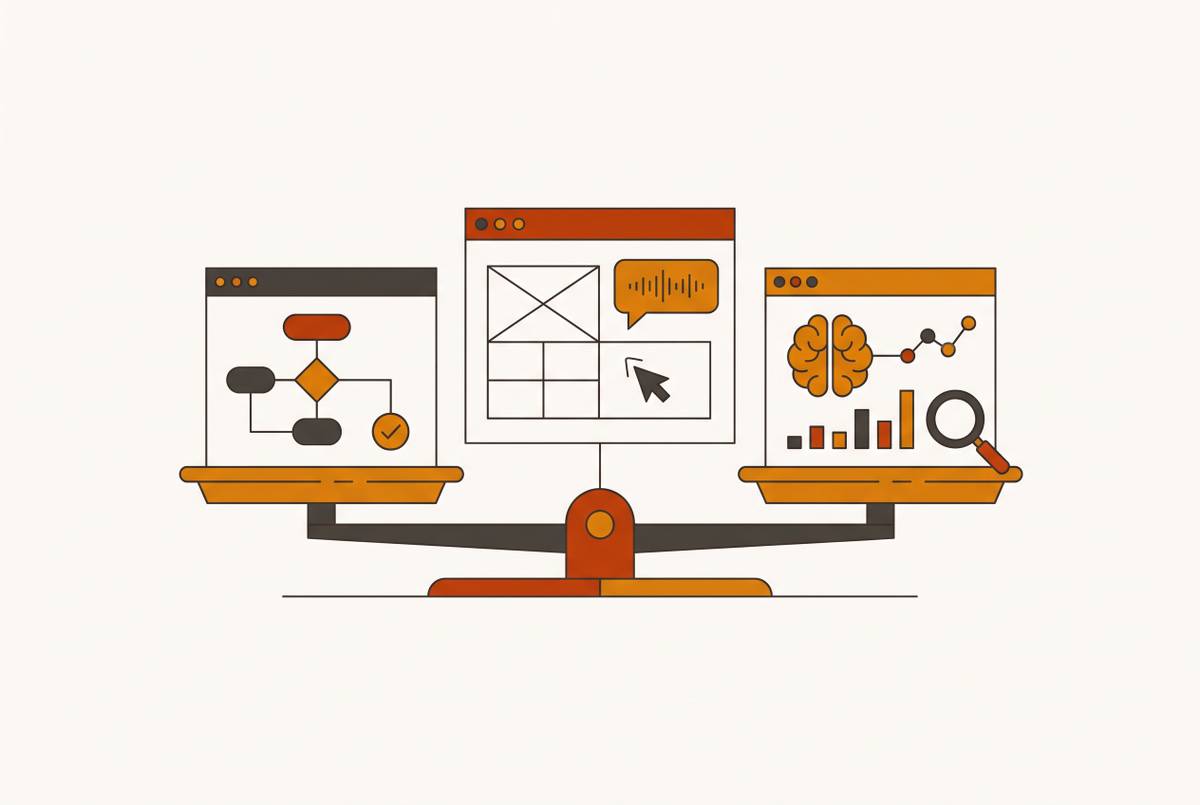
Design roles have fragmented into three different jobs hiding behind one title.
A recruiter gets a req that says "senior product designer." Without a conversation with the hiring manager, there's no way to know which job that actually is: a UX generalist who runs user research and ships wireframes, a design engineer who codes in production, or a conversational AI specialist shaping how a model talks to people. The title hasn't kept pace with what the job has become, and in 2026 that gap is wide enough to swallow an entire hiring process before it starts.
Look at what companies are actually posting. Anthropic's listing for a Product Designer on Claude Code prefers experience prototyping in HTML, CSS, and a common scripting language for the web, though it's not a hard requirement, and asks candidates to be "AI-native in how you work," already using Claude Code or similar tools day to day. Vercel's Design Engineer role asks for strong programming skills, fluency in Next.js, comfort with CMS platforms and analytics tools, and a working style built around iterating directly in code. None of these three roles would read as interchangeable to the people doing the work. All three could plausibly be titled "product designer" on a job board.
The a16z Design Engineer Fellowship stated directly what it wants, describing the candidates it seeks as "cracked designers who have absorbed engineering into their craft and are thinking in systems, not screens. That sentence is a calibration brief in miniature: a specific, testable description of what exceptional looks like for a specific kind of work, written down.
The market data confirms the title is hollowing out. UX design postings are down roughly 70% since early 2022, and UX research postings have fallen by a similar margin. The function hasn't disappeared. It's being absorbed into hybrid roles that the old titles were never built to describe, and the title compression that makes "product designer" ambiguous across companies is why recruiting for design roles in 2026 depends on calibration before a job description gets written at all. An end-to-end AI hiring manager that calibrates on a team's specific definition of exceptional can pressure-test that standard against the real market, where design engineer, AI-native designer, and conversational UX designer turn out to be three different hiring problems, and then source against the calibration.
What a job description is built to do
A job description is asked to do two jobs at once: define the role for the people making the hire, and market that role to people who might take it. Those two jobs pull in different directions, and a single document can't fully satisfy both.
Every line in a JD is a compromise between internal accuracy and external appeal. Phrases get softened, requirements get generalized, and whatever made this specific opening different from the last one gets smoothed out until the posting reads like every other listing in its category. One document is stretched across two jobs it was never built to hold together, a structural problem no sharper copywriting can fix.
That compromise raises its cost before the posting even goes live, in the back-and-forth between hiring managers and recruiters. Pin's analysis found that only 34.1% of hiring managers almost always hand recruiters a clear, accurate job description to work from. That back-and-forth doesn't appear in time-to-fill reports, but it can eat a full week before sourcing even begins.
Sequencing is the deeper issue. The posting, the screening criteria, the interview, and onboarding should all be calibrated to the same target. A JD alone can't anchor any of that, because it gets written before the target has actually been established. For design roles, this does the most damage of all, because the real differentiators, taste, portfolio quality, the ability to prototype in code, proximity to how a model actually behaves, can't be captured in a bullet list without a prior conversation about what those things look like at this specific company. The structural compromise that makes a JD do double duty means the actual differentiators never make it into the posting at all. A calibration brief inverts that order. It anchors the team's definition of exceptional first, in writing, human-approved, so that screening criteria, interviews, and sourcing all calibrate to the same target from the start instead of drifting as the role gets defined in real time.
What "exceptional" now means in design
The content of "exceptional" in design is moving, and moving fast enough that a document written six months ago may already be measuring the wrong thing.
AI fluency has gone from differentiator to baseline. What's leaving job postings tells the same story as what's arriving in them. Pixel-perfect mockup language is being scrubbed from listings at leading companies. Wireframing as a standalone deliverable has largely given way to "prototype," and nearly always that means prototype in code.
Years of experience are being downgraded as a proxy for skill. Vercel states this directly in its hiring materials: "depth and quality of your experience is more important than years." It's an architectural choice that encodes a judgment about what the team actually needs from each pod.
None of this can live in a static template. A document built six months ago can't encode whether a designer is AI-native, because that has to come from a conversation with the hiring team about what they're actually building right now. What exceptional looks like in design keeps moving, with AI fluency, vibe coding, and code-fluent design taste now functioning as baseline expectations. A living standard that sharpens with each hire holds up better than a document frozen at the moment it was written. Platforms that treat calibration as an ongoing, feedback-driven definition, rather than a template filled out once and forgotten, have a better shot at keeping a team's hiring standard in step with how fast the role itself is changing.
What the calibration brief contains that a job description structurally cannot
A calibration brief is a different document answering a different question: who, specifically, is exceptional for this team, right now, before any public-facing copy gets written.
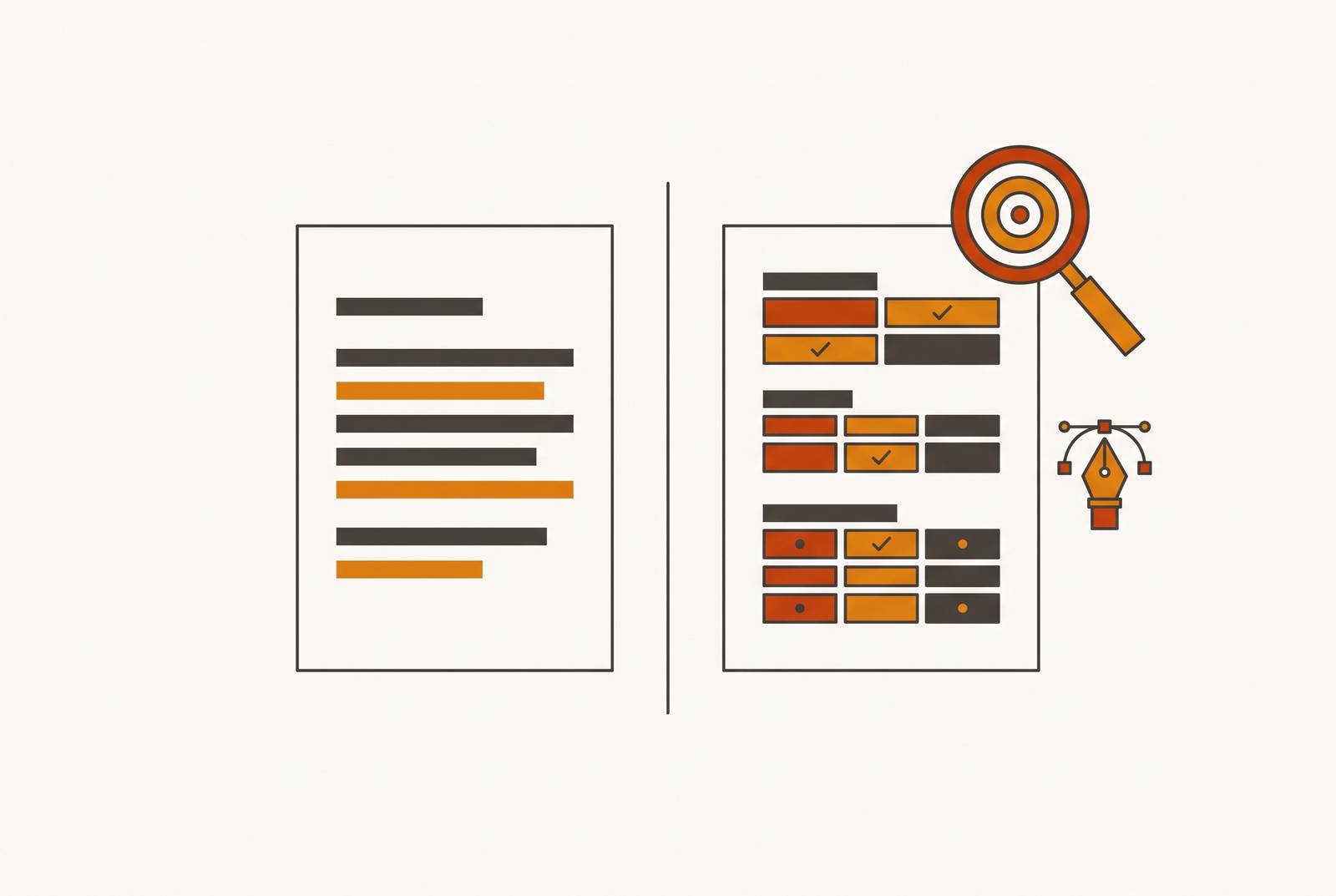
Where a JD describes the role, a calibration brief describes the standard, what exceptional actually looks like in practice, at this company, for this team's actual work. Take portfolio quality. A JD says "strong portfolio." A calibration brief specifies what counts as evidence: shipped product at a certain fidelity, a prototype that ran in production, a system built without a handoff partner at all. That's a testable standard, not a phrase every other posting in the category also uses.
The brief also forces a separation between must-haves and nice-to-haves that a JD routinely blurs. A calibration brief that resolves the must-have versus nice-to-have question before the JD gets written prevents the twenty-bullet wall that drives that self-selection at the posting stage.
A brief can also hold the team's actual working method, something a JD has no real place for. Prototype rapidly using tools like Lovable or Framer? That context is invisible in a bullet list, yet it's essential to judging whether a given candidate will actually fit the day-to-day work. The brief can name what the first 90 days actually require, not "drive impact" but the specific decision or artifact the person will own first, and it can name the skill adjacencies a team is genuinely willing to develop versus the ones it isn't, so a candidate without a named credential but with an adjacent capability doesn't get screened out by accident.
What makes this more than internal paperwork is that it's inspectable. Only a real calibration conversation can draw the line between, say, Anthropic's requirement that a designer already use Claude Code or a similar tool, and a different team that values interest in AI without requiring current fluency. A bullet-list JD can't hold that distinction. A calibration brief is built to.
The structural compromise described earlier, a JD doing double duty as internal definition and external marketing, leaves the real differentiators living in recruiter intuition and hiring manager back-and-forth. When that standard is explicit and approved up front, sourcing and screening can search for signal instead of matching credentials, and the entire hiring loop, from outbound messaging through interview through assessment, works from one shared definition of fit.
How a missing or vague brief poisons every downstream step
A missing calibration brief is a problem that compounds, because the JD functions as the foundation for every decision made about that role afterward. Vague screening criteria produce the wrong shortlist. A wrong shortlist produces the wrong interview. A wrong interview produces a mismatched hire, and a mismatched hire produces a rough first 90 days.
Over-specification and under-specification fail in opposite but equally costly ways. Calibrate them to what the role actually needs and the search compresses.
Under-specification generates a different failure: false positives at scale. Pin's 2026 analysis found that recruiters using skills-based and outcome-based formats report 35% fewer interviews per hire, because clear criteria up front filter out poor-fit applicants before they ever reach a phone screen. For design roles, those false positives carry a steep cost: portfolio review, design exercises, and multi-stage interviews all take real time, and every mismatched candidate who makes it to the panel represents hours of calibration work that never needed to happen.
Automation doesn't fix this gap. It widens whatever gap already exists. An AI agent executing against a vague brief will optimize at scale for exactly the wrong candidate, because automation amplifies clarity and amplifies fuzz in equal measure. Chipotle's deployment of Paradox's hiring automation illustrates the general pattern: automation moves fast on whatever instructions it's given, clear or not, so whatever precision or vagueness exists upstream gets scaled, not corrected. For design roles specifically, where portfolio, taste, and judgment carry the real signal, an AI system working from an imprecise calibration defaults to credential proxies instead, title, employer brand, years of experience, which happen to be exactly the signals leading design teams are actively trying to move past.
None of this is a fringe problem. Most hiring runs on the calibration gap as the norm.
The strongest objection: calibration briefs can encode bias as precisely as they encode taste
A calibration brief is only as good as the conversation that produces it, and that's where the sharpest objection to the whole approach lives. A brief encodes the hiring manager's prior assumptions, not some neutral read of the role's actual need. When that prior is biased, the brief becomes a precision instrument for replicating the existing team rather than a tool for defining what the team needs to become.
If a calibration session does nothing more than describe what the current team already looks like, it won't surface a new standard. This risk is not hypothetical. Bias mitigation techniques exist, but their measured impact so far has been modest.
For design roles, the risk takes a particular shape. "Culture fit" and "taste" sit among the most subjective dimensions any calibration session can surface, and without explicit language describing what taste means in terms of the work actually produced, those are the dimensions most likely to quietly encode demographic preference.
The fix is to make the resulting standard inspectable. A brief that specifies outcome signals, a prototype that ran in production, a system built without a handoff partner, rather than credential proxies like five years of experience or a degree from a named school, ends up both more accurate and less likely to systematically exclude good candidates. The structural fix runs the same way it did for the twenty-bullet wall: separating must-haves from nice-to-haves explicitly, in writing, with a human reviewing the choice, rather than letting either list get buried inside a system prompt or a recycled template. Every change to the standard stays visible and reasoned, not hidden inside a black box. That's what keeps a calibration brief from becoming a more efficient way to hire the same kind of person twice.
What a calibration session for a design role looks like in practice
A calibration session is a structured conversation aimed at surfacing a specific, testable standard, the kind of standard a job description structurally cannot hold on its own.
What does the best work this team has shipped actually look like, and what did the designer behind it do differently from everyone else on the team? What does the team's actual working method look like day to day, code-first iteration, Figma with handoff, rapid AI-assisted prototyping, and which of those does a new hire need to step into on day one, grown into over a year?
What would the first project this person owns actually require of them? Where is the team genuinely willing to develop a skill in a promising hire, and where is a gap simply disqualifying regardless of how strong the rest of the portfolio is?
Answering these questions honestly takes more candor than most intake meetings get, because it means naming what the team actually values instead of reaching for the safest, most defensible-sounding description. That honesty is what a calibration brief is built to capture, and it's what lets a job description, once it finally gets written, say something true.