AI Interview Tools for UX Designer Roles Compared
Generic AI screening tools miss what actually signals strong UX design ability.
Generic AI screening tools fail UX designer hiring because they measure the wrong things. They count credential keywords and job titles, but the real signal, the reasoning behind a design decision, the way a candidate tells the story of a product, how they navigate a disagreement with an engineer, appears only in conversation.
Picture two resumes. One lists "Figma" and "user research" under skills. The other belongs to a designer who has shipped a design system used across a dozen product teams. To a keyword-matching tool, these two candidates can look identical. Google's own UX interviews ask questions like "Why did you make this design decision?" and "Walk me through a product you designed that faced adoption issues, what did you learn, and how did you approach the redesign?" Those are follow-ups, asked after a first answer, built to go deeper depending on what the candidate says. A tool that runs down a fixed list of questions in order has no way to ask them.
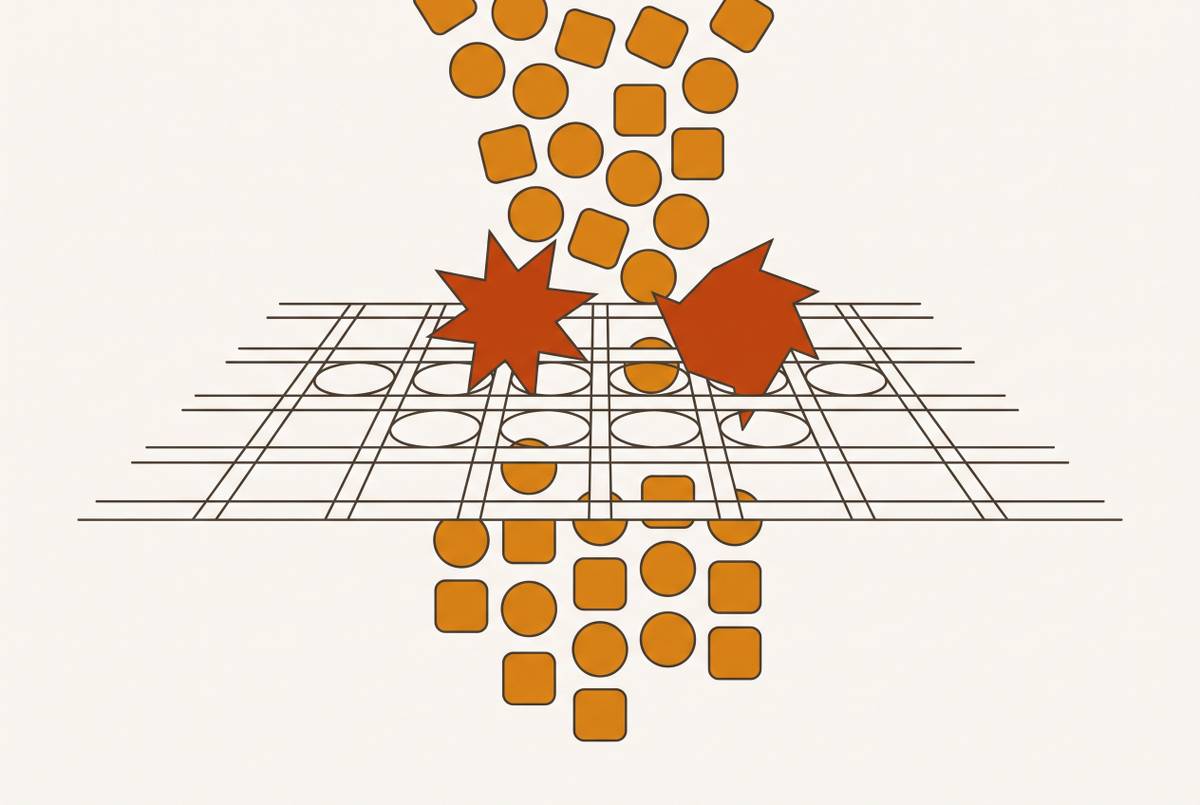
The problem is getting worse, not better. Application volume has climbed sharply across design roles, and a growing share of candidates now use AI to polish their resumes and cover letters. That makes credential-matching an even weaker proxy for actual design ability than it already was. The practical result cuts both ways: hiring teams relying on generic tools end up interviewing polished-but-hollow candidates who can't explain a single tradeoff, while strong designers with nonlinear paths, career switchers, people from adjacent fields, get filtered out before anyone ever talks to them.
What a UX interview needs to evaluate
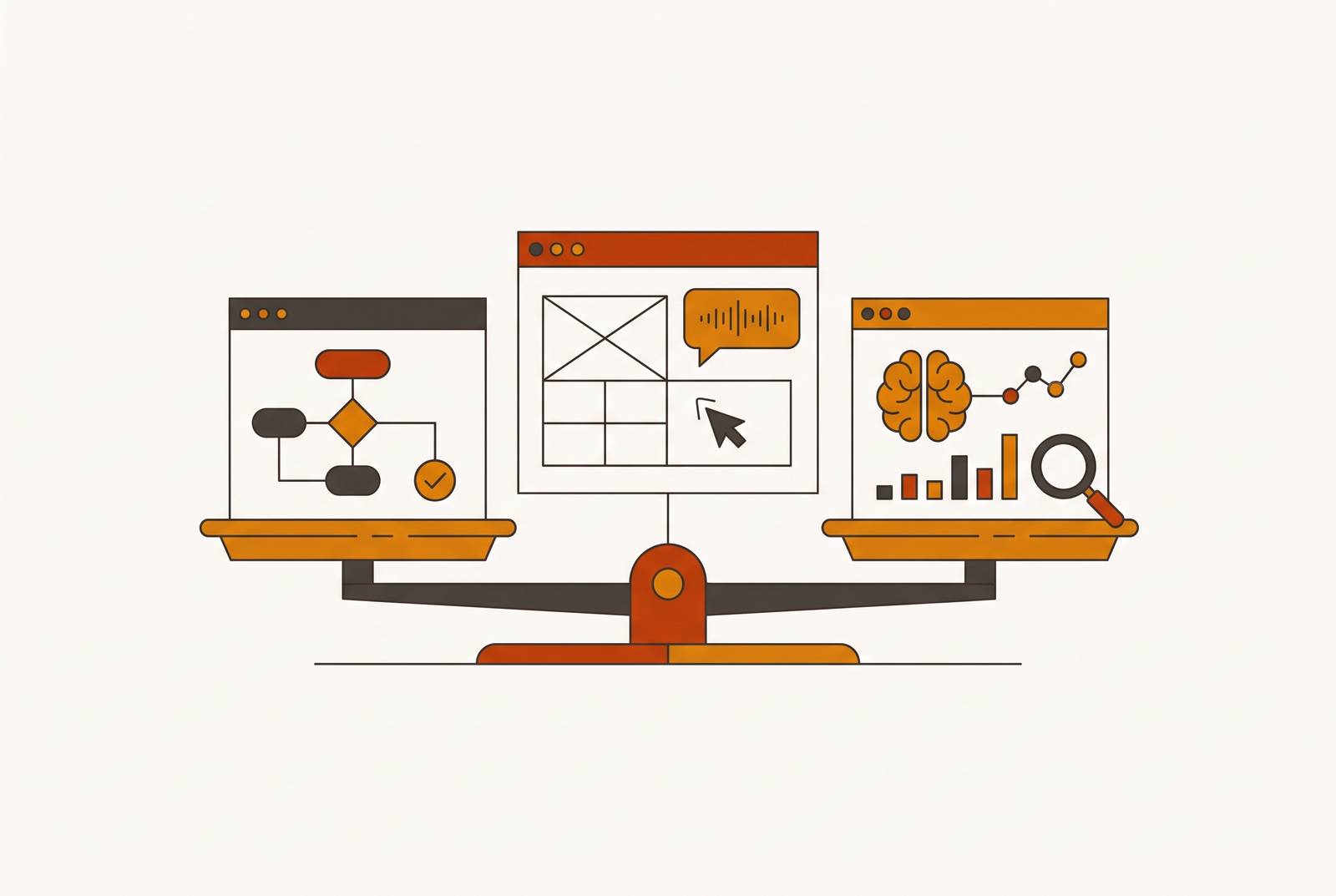
Judging a UX designer well means testing three separate things: how they reason through their own portfolio, how they describe their process, and how they work with people outside design. Each one asks something different of an AI interview tool, and most tools on the market were never built to do any of the three.
Start with portfolio reasoning. Can the candidate explain why they made a specific choice, what alternatives they considered, what they rejected, and what happened after? Describing what was built isn't the same as justifying it. This only surfaces through probing. A tool has to recognize a vague or incomplete answer and ask a sharper follow-up, the way a skilled interviewer does when a candidate says "we redesigned the onboarding flow" without saying what was broken about the old one or how they knew the fix worked.
Design process is the second piece, and it's usually tested through a live challenge: improve this screen, redesign this flow, think out loud while you do it. The value here is in the thinking, not a correct final answer. An AI tool scoring this has to track whether the reasoning holds together under pressure, not whether the candidate lands on some "right" layout. Candidates who can frame the problem, name their role, walk through their process, and state the outcome are far easier to evaluate than those who describe their work impressionistically, jumping between steps without a throughline.
Cross-functional collaboration is the third piece, where a lot of scoring systems quietly stop looking. Google's "Googleyness" and behavioral questions in UX interviews exist specifically to test collaboration and communication, how a designer negotiates with a product manager, how they respond to engineering pushback, not some abstract notion of culture fit. A tool that only scores the visual or structural quality of a design output misses this, because none of it is visible in the artifact. It appears in how the candidate talks about building it with other people.
One more filter matters in practice: authenticity. As more applications carry AI-generated language, judging a candidate's actual reasoning in a live, adaptive conversation holds up better than judging a written submission or a polished resume. A real-time exchange is harder to fake than a paragraph.
Calibration Before Any AI Interview Tool Runs
None of this works without calibration first. An AI interview tool can only produce useful signal on UX candidates once the hiring team has turned "exceptional" into specific, structured criteria, before any screening starts. Calibration is the condition that makes everything downstream mean anything, not a setting to tweak after launch.
A common failure: a hiring team drops a job description into a screening tool and treats that as the standard. But a job description is a list of requirements. It says nothing about what great actually looks like for this team, on this product, at this stage of the company. For a UX role, real calibration means spelling out what kind of portfolio reasoning the team actually values, which research methods the role genuinely demands, what collaboration looks like day to day on this specific team, and what "ownership" means in this product's context. None of that lives in a job posting.
If you skip this step, AI screening defaults to a generic template of what a UX designer should look like, rather than the specific judgment the hiring manager actually holds. That's how strong, non-obvious candidates, career switchers, designers coming from adjacent fields, people with portfolios that don't follow a tidy linear arc, get filtered out before a human ever sees their work. Practitioners who build hiring systems recommend encoding this calibration before any AI agent touches the candidate pool, and then auditing the results regularly to check they still match what the hiring manager actually values, not just what the original job posting said.
Generic screening tools infer hiring standards from job descriptions rather than learning what exceptional actually looks like for a given team. Systems like Lantern take a different approach: they learn a company's specific definition of UX excellence in about fifteen minutes of calibration, then apply that standard to filter candidates, instead of running every applicant through a one-size-fits-all credential template that misses strong designers with unconventional backgrounds. A tool that asks a hiring team to define "exceptional" up front, and that makes every later change to that standard visible and subject to human approval, holds up better for UX hiring than one that auto-generates its criteria from a job posting and leaves them static from there.
How the Leading AI Interview Tools Perform
Measured against what UX hiring actually requires, adaptive portfolio questioning, scoring for process articulation, detection of collaboration signals, and calibration before screening even starts, the tools available today split clearly. Some were built for hiring volume in general. A smaller set was built with this kind of evaluation in mind.
Lantern is built as a full-cycle AI hiring manager rather than a single point solution, which matters because the structural failure UX hiring exposes is one where taste, market intelligence, and execution sit in three different hands: a hiring manager who knows what good looks like, a recruiter who knows the market, and a tool that just runs process. Calibration is where Lantern starts: it learns a company's definition of exceptional in about fifteen minutes, encoding what the hiring manager actually values rather than what a job posting lists, before any candidate is screened. Every change made to that hiring standard afterward is visible and needs human sign-off, and that matters for UX roles in particular, since what counts as strong portfolio reasoning can shift as a product matures or a team's priorities change. From there, Lantern runs interviews that move past a fixed script, evaluating portfolio reasoning, process articulation, and cross-functional signals against the calibrated standard, and it delivers only the candidates worth meeting, each with evidence attached. It's built for founders and lean HR teams without a dedicated recruiting function, backed by Y Combinator, which makes it a natural fit for early- and growth-stage product teams hiring their first or second UX designer.
Mockin sits on the other side of the table. It's an AI-powered career toolkit built for UX, UI, and product designers preparing for interviews, and hiring teams don't run it. Its features include mock interviews with adaptive follow-up questions, a portfolio checker that evaluates work against what design managers look for, a resume checker, a LinkedIn checker, and a job matcher. It draws on more than 200 real interview questions covering design thinking, product thinking, collaboration, leadership, and motivation, and more than 15,000 UX, UI, and product designers have used it. One user review highlights how the adaptive follow-up feels real ("it actually thinks and follows up based on your answers"), and another notes that its portfolio review covers up to three case studies, which the reviewer points out matches how many case studies most recruiters actually look at. None of this makes Mockin a hiring tool. What it does is show hiring teams what a well-prepared candidate now looks like walking into an interview: a clear, structured story, a rehearsed case study walkthrough, and a ready answer for "why did you make this decision. A hiring team can use that baseline to calibrate what genuine depth sounds like versus a well-rehearsed script.
int. takes a different angle again. It's a real-time interview intelligence platform built to close the gap between running an interview and being able to act on what happened in it, solving the familiar problem of a hiring decision made from memory three days later. Its real-time analysis surfaces skill markers, communication patterns, and collaboration signals as they come up live, its interview timeline tracks every part of the conversation without a recruiter scribbling notes, and its CV integration moves candidate data in from existing recruitment platforms and back out to the downstream applicant tracking system. It's described as giving "a defensible foundation for decisions that used to depend on gut feel," which matters for UX hiring specifically, since portfolio critique decisions get second-guessed and re-litigated more than most hiring calls. Where int. earns its place is in post-interview analysis, comparing how several candidates articulated their design process across structured interviews. What it doesn't offer is calibration of what exceptional looks like for a specific UX role, and it has no sourcing or outbound capability. It's an intelligence layer sitting on top of interviews someone else still has to set up and run.
Nora AI, like Mockin, is built for the candidate, not the hiring team. It offers structured practice tied to real company processes, including a detailed walkthrough of Google's UX designer interview, covering portfolio presentation, design challenges, and behavioral questions. Its practice modes split by purpose: Standard Mode for a realistic mixed interview spanning background, technical, product, and behavioral questions; Behavioral Mode for case studies about ownership, failure, and working with stakeholders; Technical Mode for coding, system design, and production AI questions; and a Salary Negotiation Mode for offer conversations. Its real value to a hiring team isn't the product itself but what its documentation confirms: at a company with Google's hiring bar, portfolio reasoning and the ability to articulate design thinking, not credential matching, are what actually decide the outcome.
Putting the four side by side, a clear line appears. Mockin and Nora are genuinely useful for understanding what a well-prepared candidate brings into the room, but they're built to help candidates pass interviews, not help teams run them. int. adds real analytical rigor to interviews that are already happening, but it doesn't touch calibration or sourcing. Only a full-cycle system like Lantern covers the whole chain: it calibrates what exceptional means for a specific team, runs the interview itself, and hands over a shortlist of candidates with the evidence behind each one attached.
Where AI Interview Tools Still Require Human Judgment
Even the best AI interview tools can't take over the points where UX hiring decisions actually get made: judging a portfolio, watching how someone thinks through ambiguity, reading whether someone will fit the team, and making the final call. Trying to automate these is where the riskiest false positives creep in.
Portfolio critique asks for interpretation, not just evaluation. It takes a designer or an experienced hiring manager to judge whether a design decision reflects real systems thinking or just a surface-level pattern copied from somewhere else. An AI tool can surface what a candidate said about their work. Whether that explanation holds up under real scrutiny is a different question, and it's one a person has to answer.
The same goes for a live whiteboard challenge or design exercise. What matters is watching how a candidate structures ambiguity as they go, not just grading the answer they land on at the end. An interviewer who can redirect a candidate mid-thought, sit through a pause instead of rushing to fill it, and distinguish someone reasoning in real time from someone performing confidence they don't actually have, is doing work no current AI interview tool is built to replace.
Reading culture and collaboration fit takes the same kind of judgment. Whether a candidate's cross-functional experience actually maps onto a specific team's engineering culture, product velocity, and stakeholder dynamics is a call a hiring manager has to make using the evidence in front of them. It isn't a number a system can calculate on its own.
There's a governance reason behind this too, not just a quality one. Letting an AI system reject UX candidates with no human review in the loop is a quality risk, and in a growing number of jurisdictions, a compliance problem as well. The workable model has AI building and narrowing the candidate pool, and people making the final call. The right AI interview tool for a UX role is one that hands a hiring manager a shortlist with the evidence attached, narrowing the field down to people genuinely worth meeting, with the reasoning behind that shortlist visible, rather than one that tries to make the hiring decision on its own. Good collaboration between a hiring team and an AI system looks like that division holding: the system doing the work of finding and narrowing, the people doing the work of judging and deciding.