Difference Between Culture Fit and Performance Criteria
Separating performance from culture fit prevents bias from hiding in vague hiring decisions.
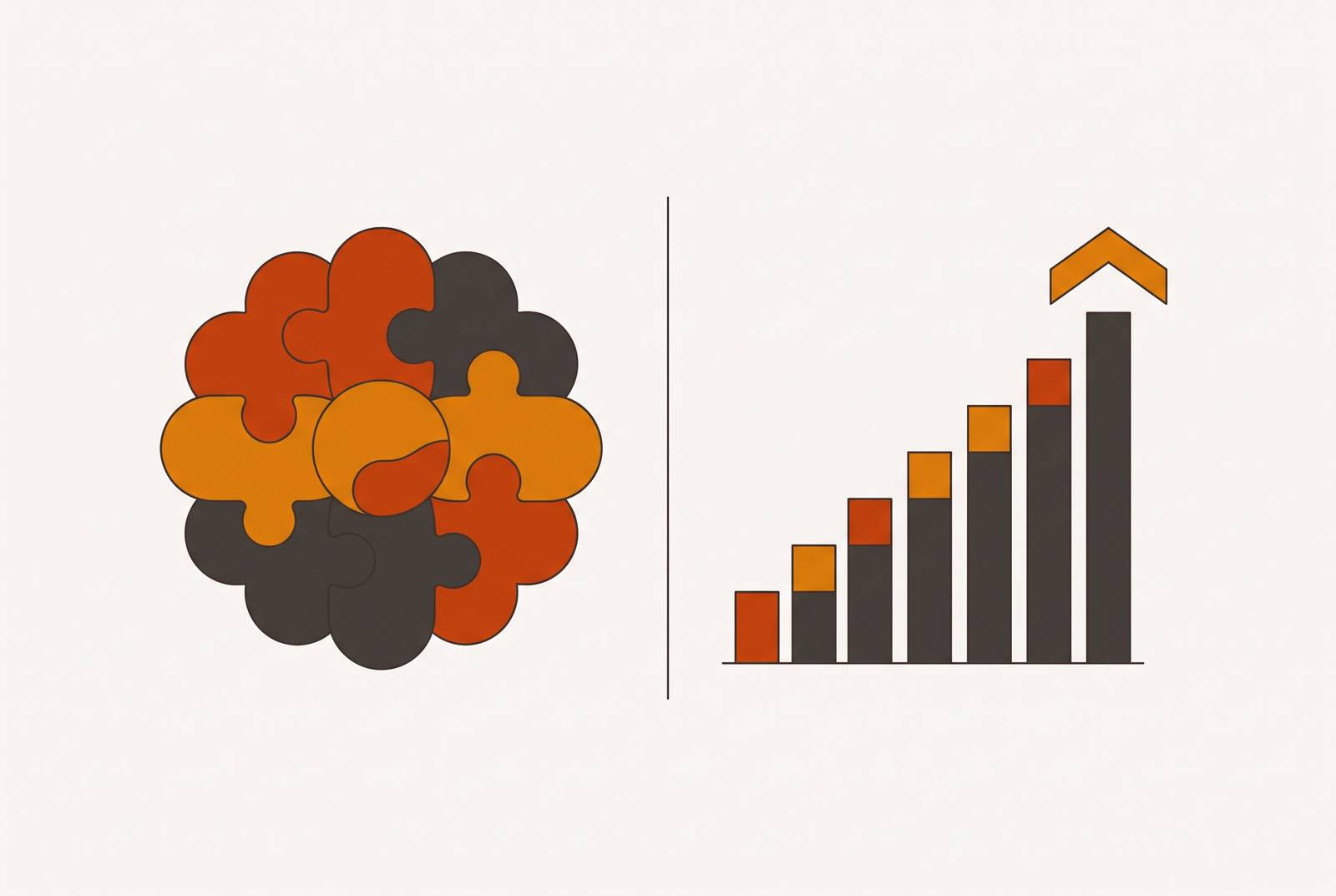
Culture fit and performance criteria answer two different questions, and most companies never bother to separate them. One predicts whether a candidate works well alongside the team. The other predicts whether they can actually do the job. Mixing the two turns a hiring process into a bias machine, one that rewards familiarity over evidence, and most hiring teams never notice they're doing it.
A candidate can be a phenomenal culture fit and completely unable to hit the outputs the role requires. Another can blow past every performance benchmark and still clash badly with how a team runs day to day. Treating either trait as a stand-in for the other is where hiring breaks, usually one of two ways: culture fit turns into a vague catch-all that lets bias hide in plain sight, or performance criteria get defined so narrowly that strong, non-obvious candidates never clear the resume screen. Between the two, the vague one does far more damage. Nobody can audit a feeling, and that's the whole problem in five words.
How unstructured culture fit assessments became a bias vector
A hiring manager asked to define "culture fit" without a rubric in front of them will reveal a pattern fast. More often than not, they describe someone who reminds them of themselves, or of someone already on the team. That's homophily: people gravitate toward others who look, talk, and think like they do, usually without noticing they're doing it.
Northwestern sociologist Lauren Rivera studied this directly, publishing her findings in the American Sociological Review in 2012. What hiring managers described as gut instinct turned out to be pattern-matching on social similarity: shared hobbies, shared schools, shared ways of talking about work. None of that predicts job performance. All of it predicts who gets hired.
A meta-analysis in PNAS, pulling together 28 field experiments and 55,842 job applications, found that white applicants received 36% more callbacks than Black applicants, and 24% more than Latino applicants. Separately, an NBER field experiment found that applicants who disclosed a disability received 26% fewer expressions of employer interest than otherwise comparable candidates. Neither gap is a coincidence. Both are what happens when "fit" gets evaluated without anyone writing down what fit actually means.
Forbes has reported that 89% of hiring failures trace back to cultural misalignment, and that number is why so many companies lean hard on culture fit screening. It's the wrong lesson to draw from it. Unstructured screening, built on vibes and interview-room chemistry, doesn't prevent that failure. It relocates it. Candidates who would have thrived get filtered out before anyone tests whether they'd thrive. Candidates who perform well in a 45-minute conversation sail through regardless of whether they can do the job.
Assessing culture fit isn't the mistake. Assessing it informally, with no documentation and no agreed criteria, is where the damage happens. Good performance criteria force interviewers toward specifics: what did this person build, what decision did they make, what happened next. Culture fit, left vague, invites something easier and worse: swapping a feeling in for evidence.
Performance criteria: what they look like and what they commonly miss
Good performance criteria describe outputs. Not credentials, not pedigree, not where someone went to school. What will this person actually build, ship, or decide once they're in the seat?
A familiar job title from a well-known company feels like a signal. It's evidence that someone got hired somewhere else once, nothing more. Treating it as proof of anything beyond that means overlooking what the person actually did on the job, which is the only part that was ever supposed to matter.
Laszlo Bock's research at Google cuts against instinct here. He found that the capacity to learn under pressure predicted performance in demanding roles better than credentials earned under favorable conditions did. A candidate with a slightly lower GPA, who had no margin for error and fought for every point, can turn out to be a stronger hire than someone with a spotless transcript and no record of facing real adversity. The pristine resume just looks like the stronger signal. It usually isn't.
Keyword-based resume screening runs into a related trap. A system built to match job descriptions against resumes penalizes a candidate who describes identical experience in different words. Someone who "managed cross-functional stakeholder alignment" and someone who "got sales, product, and support to agree on a launch date" may have done the exact same work. Only one clears the keyword filter. That's a vocabulary gap, not a competence gap, and it screens out strong candidates before a human ever reads the application.
What separates a usable performance criterion from a vague one comes down to specificity. It should name the actual outputs the role is accountable for producing, describe the competencies needed to produce them in behavioral terms rather than adjectives, mark which capabilities need to exist on day one versus which can be built after hire, and set how success gets measured at 90 days, six months, and a year out.
Most job descriptions skip all of this and list inputs instead: years of experience, a degree, familiarity with a specific tool. Inputs are easy to write and easy to screen for. They're also a weak proxy for the thing that actually matters, and weak proxies let mediocre hires slip through a well-intentioned process.
Where each criterion belongs in the evaluation sequence
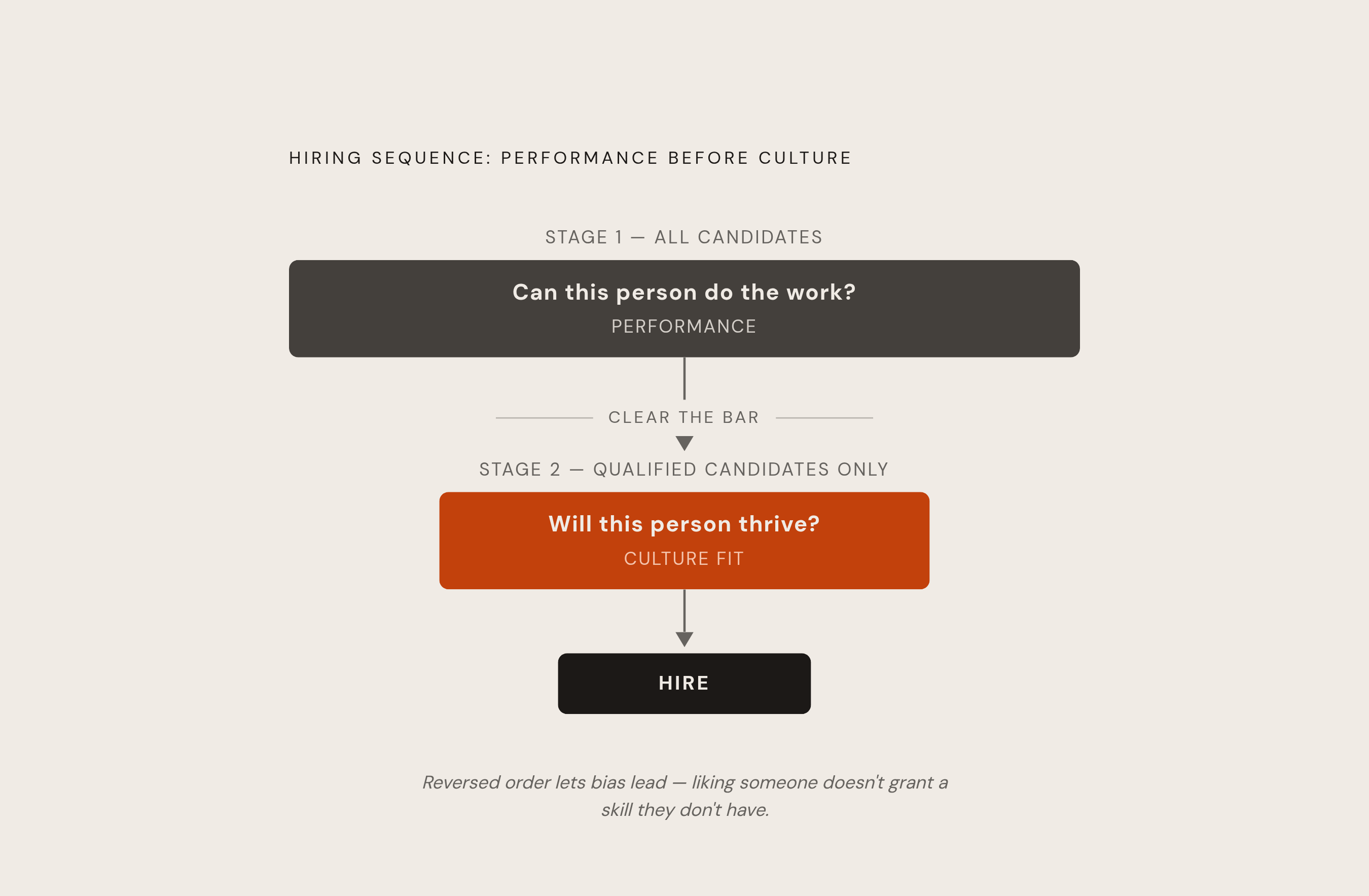
Performance criteria go first, early in the funnel. The one question to answer there is narrow: can this person do the work, at minimum, to the threshold the role requires? Getting that sequence backward lets weaker candidates start advancing on likability before anyone checks whether they can do the job.
Culture fit comes after, once a candidate has cleared the performance bar. Only then does the question shift to whether this person works well within this specific team's specific environment. That question deserves a real answer. It's just not the first one, and treating it like the first one is how bias gets a head start.
Sequence controls which trait gets to override the other. Assessing culture first turns "I really like this person" into a quiet justification for forgiving a skills gap that should have disqualified the candidate. Assess performance first, and that bar stays a lot harder to move, because liking someone doesn't retroactively hand them a skill they don't have.
Which skills does the role need immediately, and which can develop with support after hire? That question is where performance and culture actually intersect instead of compete. It's what lets a hiring team fairly weigh a high-fit candidate with some gaps against a stronger-background candidate who might take longer to integrate.
Structured behavioral interviews are the right tool for culture at this stage, because structure is what makes fit measurable instead of intuitive. Assessing competencies through structured interviews predicts job performance substantially better than unstructured conversations do. That gap alone should end the argument for any team still relying on "how did the conversation feel."
Calibration needs a few things locked down before interviews even start: job requirements agreed on and written in advance, documented evaluation criteria covering both performance and culture, shared scoring benchmarks across every evaluator on the panel, and a clear split between which scorecard items measure output and which measure working style.
None of this is procedural window dressing. It's a bias control. When criteria exist on paper before the first candidate walks in, gut feel has a lot less room to quietly override the evidence sitting in front of an interviewer.
The calibration problem: keeping both standards from drifting under hiring pressure
Bar drift happens quietly. A hiring manager under pressure to fill a role doesn't consciously decide to lower it. An interviewer who hasn't seen an exceptional candidate in weeks starts resetting what "exceptional" even means, without noticing the shift happened.
The two constructs drift differently, which actually makes the problem easier to catch if someone's looking for it. Performance bar drift appears in offer data when weaker candidates get through who wouldn't have cleared the bar three months earlier. Culture bar drift appears in interview notes instead, in phrases like "good energy" and "team player" that carry no behavioral evidence behind them.
Pre-interview calibration is the lever that actually works, and the timing is the whole point. Aligning interviewers on what "great" looks like has to happen before interviews begin, not after, because anchoring to whichever candidates have already been seen starts distorting judgment almost immediately.
Calibration runs in both directions, too. The rubric shapes what interviewers look for, but interviewer experience should feed back into refining the rubric over time. When one score level gets interpreted differently by different people on the same panel, that's a gap in the rubric.
Some hiring teams track this quantitatively now: average scores by competency, hire rate tied to specific scorecards, how often one interviewer's scores agree with the rest of the panel. An interviewer who consistently lands half a point above everyone else isn't necessarily wrong, but that gap needs targeted recalibration before it hardens into a pattern nobody questions.
Whatever changes get made to a hiring standard should stay visible: reasoned, documented, signed off on by a human. Not something quietly absorbed into the next round of interviews without anyone noticing. A calibration session that protects both constructs walks through job requirements for the performance side, agrees on behavioral indicators for the culture side, runs mock interviews or resume reviews against the rubric, and ends with documented standards every evaluator has actually signed off on.
Reframing culture fit as culture add, the diversity implication
"Culture fit," practiced without discipline, tends to mean one thing: keep hiring people who look like the team already looks. That's replication dressed up as a hiring philosophy, and it's worth calling it exactly that.
Culture add flips the question. Instead of asking whether a candidate resembles the current team, it asks what the team is actually missing, and whether this candidate brings a background or a way of thinking that makes the group sharper rather than just more comfortable. That's a harder question to answer honestly, which is probably why so few teams bother asking it.
There's a financial case behind this too, and it isn't small. McKinsey's "Diversity Matters Even More" report found that companies in the top quartile for gender diversity, and separately for ethnic diversity, were each associated with a substantial 39% greater likelihood of financial outperformance. That's a business result.
So how should the criterion itself get written? Culture fit needs to mean alignment with documented values and behaviors, not similarity to whoever's already on the team. "Does this person share our commitment to giving direct feedback in real time?" is a testable question. "Does this person feel like us?" is a mirror, and mirrors don't predict performance.
Written down as specific behaviors instead of vibes, culture fit becomes auditable. A hiring team can go back and check whether a given criterion actually tests for shared values, or just tests for social resemblance wearing a nicer label. The criterion that survives that scrutiny comes down to structured evidence: does this candidate's demonstrated behavior match the organization's documented operating principles. That's the line between value alignment and homophily, and it's thinner than most teams assume until they try to draw it themselves.
Defining Each Criterion Precisely Enough to Use Reliably
Defining culture fit starts with the people already succeeding in the role, not with a personality type someone imagines fitting the brand. What behavioral traits do the strongest performers on this team actually share? Not their backgrounds, not their alma maters. Their behaviors, full stop.
Vague adjectives don't translate into hiring decisions. "Fast-paced" and "collaborative" sound nice on a careers page and mean almost nothing in an interview room. "Gives and receives direct feedback in real time" is something an interviewer can probe for and score, unlike a slogan borrowed from the recruiting deck.
It also helps to separate company-wide culture from team-level microculture. A product team and a sales team can share the company's core values while operating in genuinely different rhythms day to day, and treating every team as if it needs an identical culture fit profile misses that distinction. The best source for what culture actually is, rather than what leadership wishes it were, tends to be the people already living in it. Asking staff how they'd describe the work environment reveals the real culture.
Performance criteria need a parallel discipline. Start with the outputs the role is accountable for producing. Separate what's genuinely required on day one from what can be built with support after hire, since that separation is what lets a team compare a high-fit candidate with some gaps against a stronger-background candidate fairly, instead of defaulting to whoever looks safer on paper. Define what evidence of past performance actually looks like: specific projects, work samples, decisions made under real constraints, not degree names or employer logos. Set measurable benchmarks for the first 90 days and six months, so performance ties to outcomes instead of how someone came across in the room.
Both sets of criteria need to be written down before the first interview, visible to every evaluator on the panel. Undocumented criteria can't be calibrated, and they can't be audited later when something goes wrong.
Validated personality and cognitive assessments can add a measurable baseline early in the process, before the interview itself introduces anchoring effects. Treat them as a supplement to structured interviews.
AI has a role here too, a fairly narrow one. Pattern-matching tasks: scanning applications against defined criteria, flagging keyword mismatches, tracking how scores distribute across a panel, are things AI systems handle well. Judging whether a candidate's actual evidence meets the bar is a different kind of task, and it stays with a human. A growing share of companies now let AI filter or reject candidates with limited human review. That's exactly the gap where well-defined criteria turn into false positives at scale, quietly, with nobody checking the work behind the rejection.
Why neither criterion alone produces a reliable hiring decision
Hire purely on skill, and eventually a highly capable person clashes badly with how the team actually operates. Friction builds, morale takes a hit, collaboration slows, and energy that should go toward the work goes toward managing the tension instead. Skipping any real check on fit before making the offer carries that cost, and it's predictable every time.
Hire purely on fit, and the failure runs the other direction. Candidates integrate smoothly, get along with everyone, and then can't execute what the role demands. Worse, when "fit" was never precisely defined in the first place, it opens the door to legal and reputational exposure, because an undefined standard is nearly impossible to defend after the fact.
The costs compound either way. Turnover driven by poor cultural fit can run between 50% and 60% of a candidate's annual salary. A mis-hire on performance grounds carries its own price tag: ramp time wasted, a manager's attention pulled away from everything else, a team's output dragging while everyone waits for the gap to close.
Performance criteria set the floor. Culture fit decides who, among candidates who clear that floor, is most likely to stick around, build real relationships, and grow alongside the team over time. Neither one alone answers the actual question a hiring decision needs answered: can this candidate do the job, and will they thrive on this team.
In practice, that means naming which capabilities are truly non-negotiable on day one, evaluating culture fit only among candidates who've already cleared that bar, and writing down the reasoning behind the final call. That's what makes a hiring decision auditable instead of instinctive, something a team can defend and learn from later rather than something that just felt right at the time.
AI can surface candidates, run scoring rubrics, track drift across a panel, and flag when something looks inconsistent. It can't make the final call, the one where performance and culture get weighed together against the real stakes of a specific team at a specific moment. That call needs a human who understands what "exceptional" actually means for this company, and who's willing to take responsibility for the answer. Hiring doesn't fail because teams lack criteria. It fails because taste, judgment, and execution have always lived in separate hands, and bringing both constructs under one documented, consistent standard is what finally lets them work together instead of against each other.