Role-Specific Quality Definitions for Technical Hires
Specify what excellent work actually looks like before screening resumes, not after hiring fails.

What a role-specific quality definition is
A job description lists years of experience, a tool stack, and a degree line as inputs. A quality definition specifies outputs, meaning what excellent work actually produces in this role, at this company, right now. Most companies only ever write the first document, then wonder why the interview loop can't tell a strong candidate from a well-rehearsed one.
The fix is writing down, before the first resume shows up, what a yes actually looks like. It's writing down, before the first resume shows up, what a yes actually looks like.
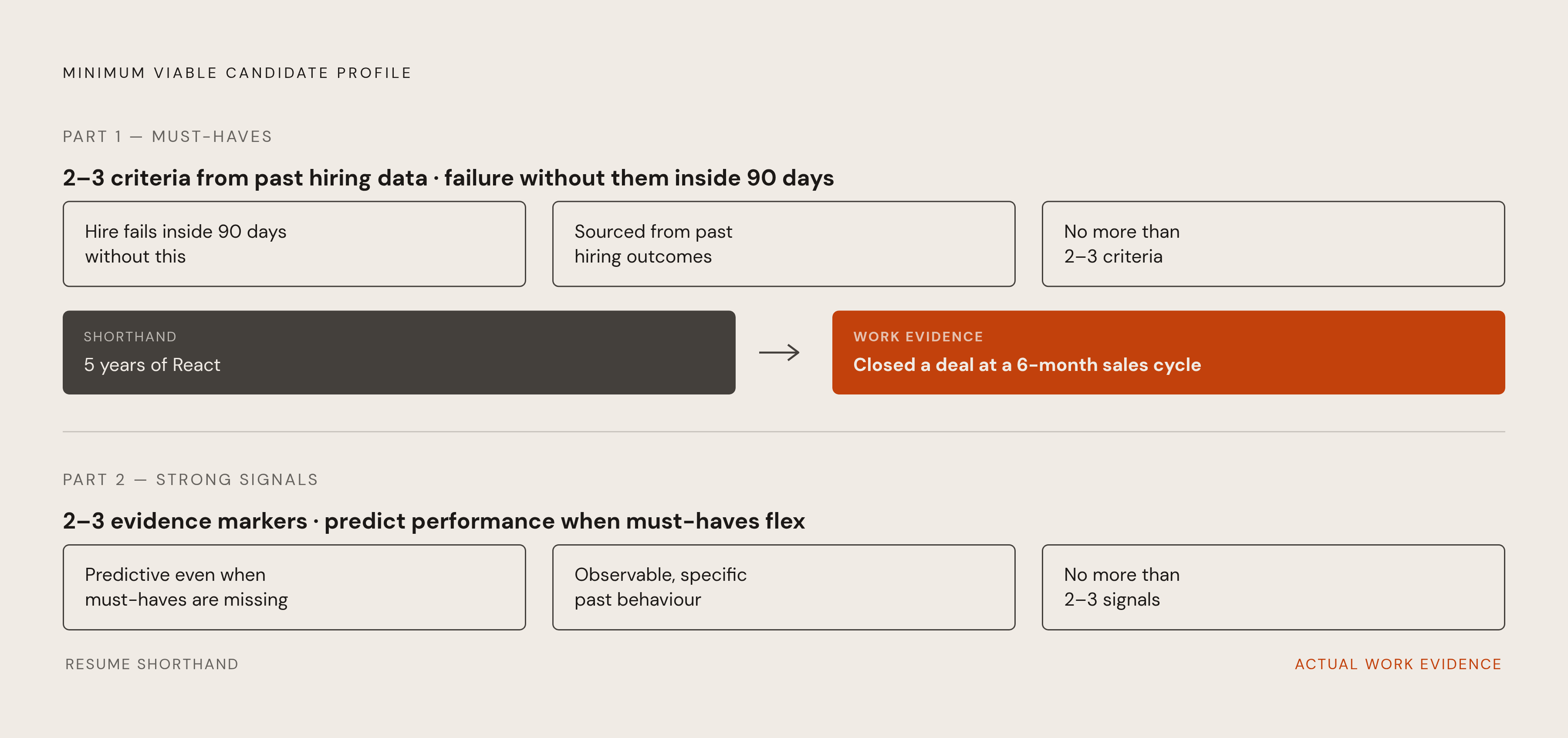
The Minimum Viable Candidate Profile (MVCP) is a format worth stealing, and it has two parts. First, two or three must-haves pulled from past hiring data, not a wishlist, without which the hire fails inside 90 days. Second, two or three strong signals: evidence that tends to predict performance even when the must-haves flex a little. For an engineer, a must-have sounds like "shipped a feature used by 10,000-plus people," not "5 years of React." For a salesperson, it's "closed a deal at a company with a 6-month sales cycle," not "quota-carrying experience." Actual work evidence, not resume shorthand.
Does writing this down before screening even matter? InterviewBox AI's candidate screening guide finds that teams documenting an MVCP before opening applications cut false positives in their shortlists by roughly half. That gain has nothing to do with a screening tool getting smarter overnight. Someone finally gave it, and the humans reading resumes, better instructions to follow.
A quality definition isn't something anyone writes once and laminates. It should sharpen every time interview feedback comes back, and every adjustment needs to stay visible and get signed off by a person. It should never drift quietly inside an algorithm nobody's watching.
The measurement check on all this is quality-of-hire: usually a weighted blend of 90-day manager ratings, early performance data, and 12-month retention. Without that tracking, there's no way to know if the definition worked or just felt right in the room. First-year attrition works as a rough proxy too. SeekOut's recruiting metrics analysis puts 12% to 15% as a common range, and anything meaningfully above that points to a mismatch between what got screened for and what the job actually demanded.
Calibration and bias are not the same failure, and treating them as one is where a lot of well-meaning teams go wrong. A quality definition built around demonstrated work product is more defensible, and more predictive, than one that quietly encodes credential patterns like "went to the same five schools we always hire from." That second kind is a bias with better paperwork. It's a bias with better paperwork.
Defining quality for software engineers and technical builders
Engineering hiring still leans hard on syntax mastery, algorithmic trivia, and framework name-dropping. That's the exact part to throw out first. Those signals may have correlated with performance during the cloud-migration hiring wave, but their predictive value has been sliding ever since. Testing someone's ability to reverse a linked list on a whiteboard tells you almost nothing about whether they can debug a production outage at 2am.
What does exceptional engineering work actually produce?
- Shipped a feature used by 10,000 or more people: a concrete proxy for delivery discipline, not just technical chops
- Made an architecture call that held up as the system scaled: judgment, not raw execution
- Debugged or rescued a system that was actively failing under pressure: reveals how someone works when things break
- Made a real contribution to a codebase they didn't start: a decent signal for collaboration and reading unfamiliar code
Hybrid disciplines, meaning engineers sitting at the intersection of two or more specialties, are commanding record compensation right now. Naming the actual intersection a role sits in (AI-adjacent engineering, systems design, whatever it is) matters more than defaulting to a catch-all label like "senior engineer" or "full-stack."
One useful benchmark: a 3:1 interview-to-offer ratio is healthy. Above 4:1 usually means borderline candidates keep reaching final rounds, and that's rarely a talent problem. It's a sign the must-haves were never specified tightly enough to filter earlier in the process.
Ask the last three engineers hired what problem they actually solved in their first 90 days. The pattern in those answers tends to beat the job posting that got them in the door, every time.
One caveat on tooling: AI resume screening is good at pattern-matching credentials and weak at judging actual capability. Research from thehirehub.ai finds that layering in a skills assessment, plus human review of candidates sitting right at the scoring threshold, catches false negatives that a pure AI pass would quietly drop.
Defining quality for data scientists and ML engineers
A PhD, or a resume full of PyTorch, TensorFlow, and scikit-learn, tells you almost nothing about whether someone can frame the right problem. Framing, not solving, is where most data science work actually lives or dies, and nearly every screening process skips this piece.
What does excellent work look like here?
- Built a model that's still in production: longevity is evidence of engineering discipline and stakeholder communication, not just accuracy on a validation set
- Took an ambiguous business question and turned it into a tractable analytical problem: arguably the hardest and most invisible skill in the role
- Made a recommendation that actually changed a decision: proof the candidate can communicate findings, not just generate them
- Noticed a model had drifted or broken and pushed for retraining or replacement, even when that wasn't the convenient answer to give
Decide first whether the open role is ML engineer or data scientist. Conflating the two produces a job posting that screens out the best of both. For ML engineering specifically, the signal shifts toward deployment reliability, managing latency and throughput tradeoffs well, and building monitoring systems. Publication count doesn't belong on that list.
The false negative risk runs especially high here. AI screening tools trained on standard resume patterns will systematically miss candidates who took a non-linear path in, someone with deep domain expertise who moved into ML later in their career, for instance. A recall benchmark of 70% or higher is a reasonable floor to hold AI screening tools to. Below that, stronger candidates are getting filtered out before a human ever opens the file. An AI hiring system calibrated on these function-specific signals, instead of defaulting to credential pattern-matching, stands a much better shot at surfacing the candidates this function tends to hide.
Defining quality for DevOps, platform, and infrastructure engineers
Kubernetes. Terraform. An AWS certification or two. That's the checklist most infrastructure postings default to, and it describes familiarity, not capability. Tool lists are the most credential-like signal in this whole category, and per available research, also the least predictive one. Someone can hold every certification on that list and still freeze the first time a production database starts throwing errors at 3am.
What actually signals excellence in this function is narrower and harder to fake: cutting mean time to recovery on an incident they didn't cause. That single data point reveals ownership and diagnostic instinct under pressure in a way no cert ever will.
"Senior DevOps engineer" means wildly different things at different companies, and that's the real problem with most postings in this category. Is this person a builder, an operator, or an architect? The evidence of excellence looks different for each one, so the quality definition has to specify which before it's useful.
The nu.edu hiring statistics compilation shows nearly 70% of companies have already shifted to skills-based hiring. Infrastructure roles stand to benefit from that shift more than most, precisely because credential signals like certifications are weak next to demonstrated systems outcomes.
How to define quality for technical product managers
The dominant filter in TPM hiring is prior employment at a recognizable tech company plus a CS degree. Neither tells you whether the person can align engineers, make tradeoffs under ambiguity, or ship a product without perfect information, which is, frankly, most of the job. Screening on pedigree instead of that is the actual mistake, and it's a common one.
What does excellent TPM work look like in practice? Start with this: shipped a product where engineers actually respected the spec. That single signal shows the technical communication worked, not just that the project limped across the finish line.
"Technical background" doesn't belong on every TPM must-have list by default, unless the role genuinely requires writing production code. Specify what depth of technical fluency the job actually needs before screening on it, or the filter ends up excluding good candidates for no real reason.
A sharper calibration question for the hiring manager: what decision in the last six months would have gone better if the TPM had done something differently? The answer to that, not the posted job description, is the real must-have.
Defining quality for security engineers and compliance-adjacent technical roles
CISSP and credentials like it test knowledge of frameworks. According to infosecinstitute.com, they don't test whether someone can find a real vulnerability, respond to a live incident, or make a risk tradeoff while a business stakeholder is breathing down their neck. Some certifications now include practical components that test hands-on skill in live environments, so not every certification in this space is equally hollow. Most of the field's credential-heavy signals still are.
Signals to specify instead:
- Found a vulnerability in a system everyone swore was clean: adversarial thinking over checklist compliance
- Explained a risk in terms that actually changed a non-technical stakeholder's decision: arguably the rarest and most valuable skill in this whole field
- Designed a control that didn't slow the product team's shipping pace: security that works alongside engineering velocity instead of against it
- Handled an incident nobody saw coming and left behind documentation that made the next response faster
For companies running AI tools inside their own hiring process, security is the internal check on candidate and client data handling. A quality definition for this role should specify AI governance and data pipeline security experience directly, alongside perimeter defense skills.
There's also a compliance-adjacent variant: roles split between security work and regulatory readiness (SOC 2, HIPAA, GDPR). The real signal there is whether the candidate has owned an audit start to finish, not whether they can recite what the framework says.
Talent market realities that should push back on your quality definitions
Talent intelligence exists to keep a quality definition honest, and most teams skip this step. Talent market analysis exists to estimate the realistic pool once seniority, location, comp, industry background, and working model are all applied as filters, before a company locks in a must-have list it can't actually fill.
Job titles go stale faster than most people expect. If a posting says "Business Intelligence Analyst" but the market is actively searching "ML Engineer" or "AI Systems Lead," the company is invisible in the exact channel where the right candidates are looking. Available research recommends auditing req titles against live posting language every quarter, not once a year.
Compensation acts as a filter on the quality definition too, and this is the piece companies most often get backwards. Cost-per-hire for non-executive technical roles runs $3,500 to $6,000 depending on company size, and executive searches often cost 25% to 35% of first-year cash comp. If the comp range attached to a role can't clear market rate for the must-haves listed, the definition needs to change; the budget line underneath it produces the same mismatch if left untouched. Raising the budget without touching the must-haves just buys the same mismatch at a higher price.
The scarcity pattern matters here as well. TechNeeds' analysis finds the tech talent market isn't broadly scarce, it's acutely scarce in specific skill categories. Knowing which must-haves on a given list fall into a genuinely scarce bucket versus a well-supplied one decides whether the right move is flexing the definition or flexing the timeline.
When should any of this get revisited? Quarterly review makes sense for roles that are strategically important or changing fast, and events like layoffs, sudden hiring surges, or shifts in remote-work policy justify moving that timeline up. A quality definition that survives contact with market reality is a more honest document, full stop. It either confirms the must-haves are achievable at the stated budget, or it forces the harder conversation about which must-haves are real and which were always just preferences wearing a must-have's clothes.
Where AI in the hiring process hides the calibration problem
AI adoption in hiring is close to universal at this point. A survey from imocha.io found 99% of hiring managers had used AI or automation somewhere in their hiring process, and The Korn Ferry 2026 Talent Acquisition Trends report found 84% of TA leaders plan to use AI in 2026.
When the quality definition feeding it is actually good, AI earns its keep in specific ways. It can match candidates against specified work evidence rather than falling back on credential pattern-matching, and it applies the must-haves consistently across a large pool, cutting down the drift that happens when five different reviewers each apply "senior-level judgment" a little differently.
That only holds if the definition feeding the system is precise to begin with, and this is where most teams get the tradeoff exactly backwards. They assume the AI is doing the calibrating, when really it's just executing whatever calibration, or lack of it, already existed before the tool showed up. An AI tool trained to pattern-match "10 years experience" and "Big Tech" will optimize for exactly that, at scale, faster than any single recruiter ever could manage on their own.
It's a mirror. It's a mirror. Whatever calibration problem already lived in the hiring team's thinking gets automated right along with everything else, just quietly, and at volume, until someone finally sits down and writes out what a yes actually looks like.