Credential Bias in Resume Screening
Companies screen out their best candidates before human review even starts.

Credential bias in resume screening isn't mainly a fairness story. It's a precision story: companies are screening out their best candidates before a human being ever lays eyes on a resume. Understanding exactly where that happens, and what these filters actually measure, explains why credential proxies keep failing the people who'd be the strongest hires.
Credential bias and where it enters the hiring funnel
Credential bias is the habit of using proxy signals, things like employer prestige, years of experience, degree pedigree, or tenure length, as stand-ins for whether someone can actually do the job. Two patterns appear repeatedly in the audit. Prestige filters narrow the candidate pool to alumni of certain employers or schools, treating a company name on a resume as evidence of quality. Experience floors set minimum years or minimum tenure thresholds, and often nobody deliberately chose that number, it just came pre-set on the sourcing platform.
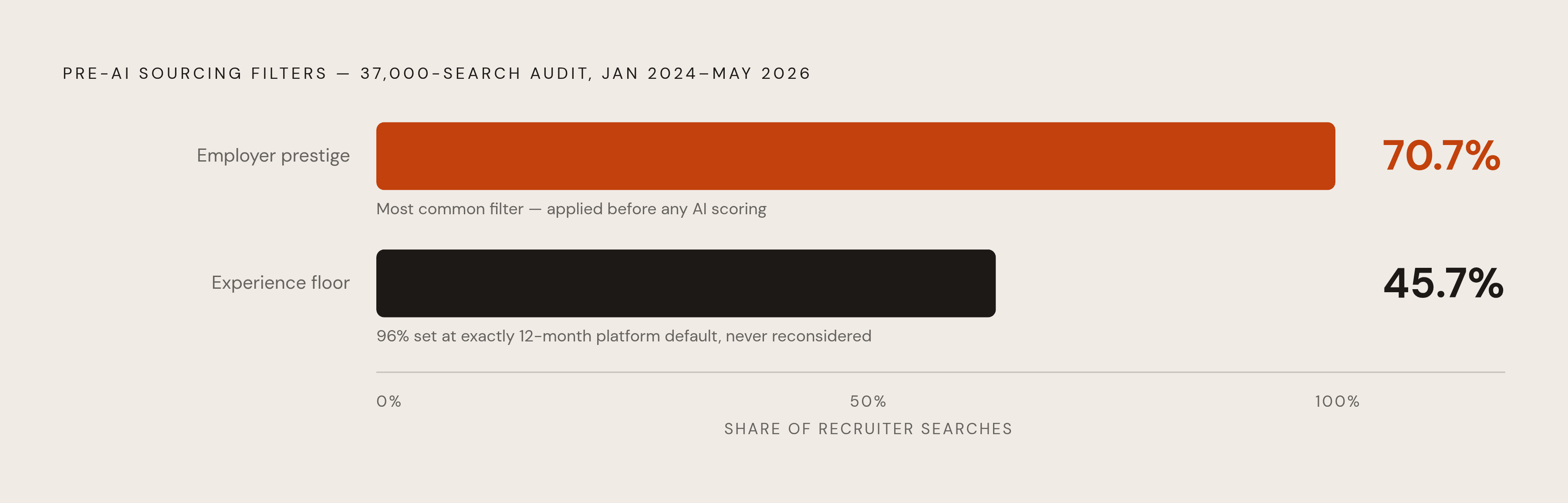
Most people assume AI is where the bias lives, but it isn't. Bias enters one step earlier, at the sourcing screen, before any model or scorer ever touches a resume. An audit of more than 37,000 recruiter sourcing searches run between January 2024 and May 2026 found employer-prestige filters applied in 70.7% of them, making it the single most common filter in use, before any AI scoring even starts.
So what does that mean, practically? It means the funnel is already narrowed before the tools everyone worries about get a chance to do anything. This isn't primarily a DEI compliance argument, though it touches that too. It's an argument about accuracy: credential filters generate false negatives at scale, rejecting qualified people simply because they don't match a pattern that was never validated against actual job performance.
Years-of-experience floors and tenure defaults doing most of the filtering work
Experience floors are the second most common bias-prone filter, appearing in 45.7% of the searches in that same audit. 96% of all minimum-tenure filters were set at exactly 12 months at a candidate's current employer because that default was never reconsidered, not because it reflects a deliberate judgment. That's not a considered judgment call made search by search. That's a default nobody bothered to change.
Why does that matter so much? Because a default that nobody examines is a default that does its damage silently. Over half of experience-gated searches, 51.9%, require five or more years, and a meaningful share push past ten. Inflated floors like that fall under the EEOC's adverse-impact framework, the four-fifths rule laid out in 29 CFR Part 1607, which has historically treated facially neutral thresholds as actionable when they end up disadvantaging protected groups.
But strip away the legal exposure for a second and ask a simpler question: what does a five-year floor actually measure? Time in role isn't the same thing as rate of learning, and it certainly isn't the same as depth of contribution. A floor set at five-plus years structurally locks out career-changers, military veterans translating a different kind of experience, people who got promoted fast, and anyone who built real capability outside the conventional ladder. Meanwhile that 12-month tenure default punishes anyone who left a bad fit early, got laid off through no fault of their own, or worked contract roles between full-time jobs. None of those things say anything about whether someone can do the job well.
The employer-prestige filter works the same trick from a different angle. It's not measuring the quality of a person's work. It's measuring the reputation of wherever they happened to work, a proxy for the environment, not the individual. Put the two filters together and you get a funnel where recruiter judgment barely factors in. The defaults are doing the screening, quietly, and almost nobody goes back to check what they're actually filtering for.
AI screeners' inheritance of these filters and its effect on credential bias
Consistent isn't the same as fair, though, and it isn't the same as accurate. AI systems trained on historically biased outcome data can replicate that bias, and in some cases make it sharper.
A University of Washington study presented at AIES 2024, later highlighted by the Brookings Institution, found AI resume screeners preferred white-associated names 85.1% of the time, against just 8.6% for Black-associated names, a gap starker than what's typically documented for human screeners working alone. The tool built to remove human inconsistency ended up producing a wider gap than the humans it replaced.
One might argue that some models dodge this problem simply by treating everyone the same. Not quite. Research described as the "Illusion of Neutrality," drawing on more than three million comparisons, found some models look demographically neutral because they aren't differentiating between candidates in any meaningful way at all. They're matching keywords, not judging fit. Apparent neutrality, in other words, can be a competence failure dressed up as a fairness win.
A Princeton study from February 2026 backs this up from another direction: many large language models couldn't consistently select resumes describing more qualified candidates, and models do not reliably abstain when ranking equally qualified candidates. So the model isn't refusing to guess, it's guessing anyway, and calling it a ranking.
Add automation bias on top of that, and the problem compounds. When an AI system flags someone as unqualified, human reviewers tend to accept that call without digging in further, which means putting a human in the loop doesn't reliably catch the AI's mistakes. That matters at scale, because roughly 90% of employers now use some form of automated resume screening, according to figures cited in the Princeton research (traced back to the World Economic Forum), and adoption among non-Fortune 500 companies was projected to climb from 51% to 68% by the end of 2025 Measuring Validity in LLM-based Resume Screening. SHRM's 2026 survey of 1,908 HR professionals found 19% of organizations using hiring automation report their tools have screened out qualified applicants. Nearly one in five organizations, saying it out loud about their own systems. Common assumption holds that AI screening is more objective than human screening because it applies rules consistently.
Credential proxies as a poor substitute for evidence of actual fit
Step back and look at what each credential actually certifies. Employer prestige tells you where someone worked, not what they built while they were there. Years of experience tells you how long someone occupied a seat, not how much they contributed or how fast they grew. A degree requirement tells you someone finished a program, not that they can do the specific job in front of them.
That mismatch produces errors in both directions. A USPTO-reviewed study found that overreliance on keyword and credential matching creates both false positives and false negatives: less qualified candidates who craft keyword-heavy resumes pass filters while qualified candidates who don't use the right vocabulary are excluded. False positives and false negatives, generated by the exact same mechanism.
A visibility gap sits directly in the numbers. Data compiled from TestGorilla and University of Phoenix research shows 85% of companies say they're using skills-based hiring as of 2025, yet 82% of decision-makers admit they lack a reliable, standardized way to actually evaluate and compare skills at scale talentpronto.ai. That gap isn't an accident. Removing a credential requirement from a job posting takes five minutes. Building a repeatable process that judges capability consistently across dozens of candidates takes real work, and when a requisition gets urgent, teams default right back to the credential shortcut they meant to retire.
Who gets caught in that shortcut? Internal candidates who advanced without a recognizable outside employer name on their resume. Veterans translating military experience into civilian terms. Apprenticeship and bootcamp graduates. Contractors and fractional workers whose history doesn't read as a clean, linear sequence. People in adjacent roles have transferable skills that never appear as the right keyword.
Unfair screening and imprecise screening come from the same filter, viewed from two angles. The mechanism that screens out a Black candidate because a name doesn't pattern-match to "prestigious" is the identical mechanism that screens out the strongest builder in the pipeline because they never worked somewhere with a recognizable logo.
Legal and regulatory requirements for teams using automated screening
Enforcement isn't slowing down. The EEOC logged 88,531 discrimination charges in fiscal year 2024, a 9.2% jump over the year before, and recovered nearly $700 million for victims of discrimination that same year. EEOC guidance is clear that liability doesn't disappear just because a decision was made by software instead of a person; an employer is on the hook either way.
That principle got tested directly in Mobley v. Workday, where a federal court allowed claims to proceed against an AI screening vendor on the theory that it could be held liable as an agent of the employers using its tool. No final liability has been decided, and the case remains in active litigation, but the fact that a court let the theory move forward at all signals where exposure is heading.
The regulatory scaffolding keeps growing around this too. Illinois passed HB3773 and Texas passed TRAIGA, both state-level AI governance laws, though their direct implications for hiring specifically are limited.
The EEOC's four-fifths rule under 29 CFR Part 1607 has historically treated facially neutral defaults, including the 12-month tenure default documented in Pin's audit, as actionable when their outcomes disadvantage protected groups, even though current federal enforcement priorities have deprioritized disparate-impact claims. Which raises a practical, uncomfortable question for any team that hasn't looked closely at its own sourcing filters: if the defaults are doing the screening and nobody's examined them, is exposure already sitting there, unexamined right along with everything else? NYC Local Law 144 mandates bias audits for automated employment decision tools (pin.com). EU AI Act Annex III provides for fines of up to €15M or 3% of global revenue for non-compliant AI hiring systems, whereas fines of €35M or 7% apply only to prohibited AI practices under Article 5, not to high-risk Annex III systems.
How skills-based calibration changes what gets into the funnel
Moving from credentials to skills isn't about lowering the bar. It's about replacing a filter that was never a reliable measure of skill with something that actually looks at capability directly.
That starts before sourcing even opens. Define what "exceptional" looks like for the specific role, in concrete terms, drawn from real examples of people who've done the job well, not from a generic job description written the year before. Separate the must-haves that genuinely predict success from credential habits that snuck in unexamined, the difference between "has shipped a product with this specific characteristic" and "has worked at a company of this specific size." And get recruiters and hiring managers aligned on the same criteria before the first resume is reviewed, because misalignment between recruiters and hiring managers remains one of the top barriers to efficient hiring, according to LinkedIn's analysis.
AI intake tools are starting to support exactly this kind of calibration: guided, asynchronous conversations that pull structured requirements out of a hiring manager's head, surface example candidate profiles to sharpen what "good" looks like, and generate sourcing criteria, interview guides, and job descriptions from one structured conversation. When evaluation shifts to skills first, differences between candidates become visible and explicit instead of buried under a resume format, producing cleaner, more consistent decisions across whoever's doing the reviewing.
Degree requirements are loosening in step with this shift. Roughly half of employers responding to NACE's Job Outlook 2025 Spring Update said their organization has positions flexible on degree requirements. Degree flexibility is becoming table stakes, not a distinguishing feature of forward-thinking employers.
Governance practices that catch credential bias after it has been built into a process
Even a well-intentioned process needs a way to catch bias after it's already baked in, because it will get baked in. One of the sharpest tools for this is false negative auditing: periodically pull a sample of rejected candidates and estimate how many were actually qualified. That measures the precision cost directly, not just the fairness cost.
Selection-rate parity checks compare shortlist rates across demographic groups, surfacing adverse impact before it compounds silently across a whole hiring cycle. Feature-importance checks look at what's actually driving a model's scores, and where legally permissible, mask proxies for protected attributes like graduation year, employment gaps, or employer-name patterns. Default audits matter just as much: examine which filters are set by platform default versus active recruiter choice, exactly what Pin's finding that 96% of tenure floors are set at exactly 12 months by default illustrates.
A 2026 governance guide from mihcm.com recommends hybrid screening flows: automatically shortlist high-confidence candidates, route the ambiguous middle band to human reviewers, and never let a rejection happen without explicit human oversight somewhere in the chain. That balances speed against accuracy and explainability, tuned to how critical the role is and what regulatory environment it sits in. And on that note, human review isn't optional on final decisions. EEOC guidance doesn't treat an automated outcome as an excuse; a person has to own the call.
Industry forecasts suggest AI-generated fake applicants could make up as much as 25% of total applications by 2028 recruitics.com. Governance built to catch credential bias also needs to catch fraudulent candidates gaming those same credential signals, a different kind of false positive entirely, one that has nothing to do with model error and everything to do with someone exploiting the exact keywords the filter rewards.
Changes teams can make now to reduce credential bias without rebuilding their entire stack
Start with the filters already running. Before the next search opens, ask what an employer-prestige filter is actually selecting for, whether the years-of-experience floor was a recruiter's choice or a platform default nobody touched, and what would happen if that floor got swapped for a direct question about capability instead.
Define "exceptional" before the job description gets written, working backward from real examples of people who've done the job well rather than forward from a template. Swap credential language in outreach and evaluation criteria for evidence-of-work language: what did this person build, ship, or solve, not where they sat and for how long. Use structured assessments and standardized rubrics anywhere a credential filter is currently doing first-pass work, so candidates with non-linear backgrounds get judged on the same terms as everyone else.
When evaluating any AI screening or sourcing tool, ask pointed questions: has it been audited for adverse impact, which signals actually drive its scores, can proxies for protected attributes be masked, does the vendor hand over model cards and bias metrics or just accuracy claims, and is candidate data being used to train shared models across clients, its own exposure separate from bias.
AI hiring systems calibrated against a company's own real definition of fit, rather than generic credential shorthand, can surface candidates that credential filters were structurally built to eliminate. Per Pin's 2026 user survey, teams that switched from credentials-first sourcing to skills-based AI sourcing saw 6x more diverse candidate pipelines compared to prior diversity sourcing tools. What that points to, in the end, is a division of labor that actually makes sense: software handles pattern-matching at scale, and people handle judgment, relationship, and the ongoing work of refining what "exceptional" means as each new hire teaches the team something the last one didn't.
Sources
- AI Resume Screening Bias in 2026: A 33,000-Job Audit - Pin
- Resume screening: AI-powered guide for HR leaders (2026)
- Measuring Validity in LLM-based Resume Screening
- Gender, race, and intersectional bias in AI resume screening via language model retrieval | Brookings
- AI Bias in Hiring: Algorithmic Recruiting and Your Rights
- EEOC Compliance Requirements 2026: Complete Employer Guide to Fair Hiring Practices