Salary Benchmarks and Market Reality for UX Designer Hiring in 2024
Specialized skills and market geography now determine which candidates a salary actually attracts.
Published salary ranges for UX designers tell hiring teams what to pay. They don't tell hiring teams who that pay will actually attract, and that gap is the real subject here. The UX job market is stabilizing after a rough post-COVID stretch of layoffs and freezes, but the recovery is landing unevenly, and that unevenness changes who shows up for any given number on the offer letter.
Senior and generalist roles are bouncing back faster. Entry-level roles remain scarce and the competition for them has gotten sharper, not softer. Why would that be, when the overall market is supposedly healing? Part of the answer is a shift in what hiring managers are actually asking when they look at a resume. The question used to be whether a designer was good. Now it's whether a designer is a risk. Teams are leaner. Planning cycles are shorter. Under those conditions, companies hire for predictability under pressure, not for potential.
That same pressure is reshaping what teams build their design functions around. Prosperity Recruitment's 2026 employment and salary survey documents a move away from large generalist design teams and toward smaller, more specialized ones. Specialized skill sets, particularly AI-driven UX work and accessibility expertise, have become must-haves rather than nice-to-haves, and specialized design roles built around those skills now command the highest pay in the field. None of this is a temporary dip that reverses once budgets loosen. It's a structural reorientation, and it means the salary number on a job posting buys a different kind of candidate than it would have three or four years ago.
What the published salary ranges cover
Start with the numbers, because they set the floor for everything that follows. The published ranges span a wide band overall, and where a specific role lands inside that band depends on factors that most job postings never spell out.
The junior-to-senior arc tells a similar story. UX Design Institute's 2024 salary analysis documents a US junior-to-senior arc that more than doubles entry-level pay by the senior stage, consistent with the Lyssna compilation. That's a wide spread across a single career, let alone across a labor market made up of thousands of companies at different stages, in different cities, with different design cultures. The number alone is a starting point. What determines where a given role actually sits inside that spread is the subject unpacked next.
Why the same number buys different talent
A salary figure only means something relative to the market segment it's competing in. Geography, remote work, and employer type each carry their own compensation premiums, so the same number produces different candidate pools depending on the market segment it's competing in, and hiring teams who don't account for that end up either overbidding or generating false candidate expectations.
Geography is the most visible multiplier. UX Design Institute and CareerFoundry both document San Francisco running well above the national average, with Seattle and New York adding smaller, but still real, premiums on top of baseline pay. Remote work complicates this further rather than simplifying it. Builtin data show a remote UX designer role commanding a salary premium over in-office roles. A remote posting doesn't let a company pay less, which puts that role into a national market where it competes against every other remote opening a candidate is considering, and candidates price that competition into what they'll accept.
Employer type adds a third layer on top of geography and work model. Large tech companies and established agencies with strong design cultures offer compensation packages that small and mid-size companies simply can't match at the base-salary level. Candidates who've been calibrated by those larger offers don't just compare numbers, they read a lower offer as a signal about how seriously a company takes design as a function. Glassdoor and Levels.fyi data put Google's median UX designer compensation at $209,000. That figure sits so far outside what most companies can offer that it distorts aggregated benchmarks for everyone else. A hiring team at a company outside the handful of giants that can pay at that level, calibrating its own offer against numbers like that, risks overbidding for a role that didn't need it, or setting candidate expectations the company has no way to meet.
Before a budget gets set, the useful question is which market segment this role is actually competing in, geographically, by work model, and by employer tier. Set the budget after answering that, not after a strong candidate turns the offer down.
Nominal salary gains versus real purchasing power losses
UX salaries look like they've been climbing. On paper, the trend outpaces many other fields. But inflation-adjusted pay in UX has actually declined over the same stretch, and the senior candidates a hiring team most wants to land are often the ones who've tracked their own real earnings closely enough to notice.
The UXPA Salary Survey found that while nominal salaries look like they're rising, real pay adjusted for inflation is down roughly 2% since 2022. That decline isn't considered statistically significant on its own. But the BLS average for 2024 represents a meaningful nominal gain from its 2021 level, and a candidate who has been in the market through that period has watched purchasing power erode even as the number on the offer letter rose.
What does that mean for a hiring team putting together an offer? Senior candidates aren't naive about total compensation. An offer at the midpoint of a published salary range can land as below-market to someone who has been doing this math in the background, even when the hiring team genuinely believes the number is competitive. Combine that with the flight-to-predictability dynamic described earlier: designers who've survived one or more rounds of layoffs are negotiating from a place of heightened risk awareness. A package that looks solid on the spreadsheet can still lose to a competing offer that signals more stability, even at a similar or slightly lower headline number. The number matters. How the offer is built around it, including stability signals, growth clarity, and honesty about the company's position, matters just as much to a candidate who has been burned before.
The market's structural shift toward specialization and who you can realistically attract
Budget is one constraint. Whether the person a budget is built for actually exists in the market is a separate one, and it's the one hiring teams tend to discover too late, after a role has sat open for months.
The shift toward specialization documented earlier isn't a passing trend, it's structural. At the same time, entry-level scarcity is tightening the pipeline from the other direction. Fewer than one in twenty tech companies are currently open to hiring entry-level talent, which thins out the pool of generalists who might otherwise grow into broader roles over a few years, and intensifies competition for the entry-level candidates the few willing companies do consider.
Demand isn't softening either. A 2026 Figma survey found that a strong majority of design leaders report their organization's need for designers has either increased or held steady, with a meaningful share reporting real growth in that demand. That means the same pool of specialized candidates is being pursued by more teams at once, not fewer.
What does that mean for how a role gets written? A job description that bundles research, visual design, systems thinking, and stakeholder facilitation into one role at a single mid-market salary is attracting no one competitive at all, or attracting someone who takes the job and leaves the moment a more focused role opens up elsewhere. The fix is a narrower, more honest scope that matches what the specialized market is actually producing.
Screening infrastructure that filters out strong candidates before salary becomes the issue
Get the budget right. Get the scope right. A role can still fail to surface strong candidates if the screening process it relies on is built to match keywords rather than recognize real work.
Applicant tracking systems dominate the first round of screening at most large companies. The vast majority of Fortune 500 companies used a detectable ATS in 2025, and a large share of UX and UI designer resumes get rejected before any human ever sees them. A Jobscan analysis found the primary trigger for those rejections is missing design tool keywords and research terminology, not any actual gap in capability. A designer with a strong portfolio of shipped, successful work can get filtered out simply for using an unconventional resume format, or for describing their process in plain language instead of listing tool names the system is scanning for.
The problem cuts the other way too. A significant share of recruiters and hiring managers report having spotted, or at least suspected, candidate deception, and a meaningful minority of candidates admit to using AI tools specifically to optimize their resumes for ATS keyword matching. So the candidates who clear the filter are sometimes just the best at gaming the filter.
That's a dual failure, and no amount of salary adjustment fixes it. What does fix it is treating evidence of actual work, what a candidate has built, what shipped, what changed as a result, as a more reliable signal than keyword density or credential matching, and designing the process to surface that evidence early.
AI's reshaping of the hiring loop for UX roles
AI tools now sit inside most hiring processes in some form.
A strong majority of hiring managers report their company has rolled out AI somewhere in the recruitment process, and the share using AI specifically to screen resumes and applications has grown sharply compared to a few years ago, according to a Resume Genius and Pollfish survey of U.S. hiring managers. The next shift already underway is agentic AI. Gartner's CHRO Priorities 2026 research found a large majority of HR leaders plan to deploy agentic AI capabilities within the next 12 months, moving past simple screening assistance toward systems that manage sourcing, initial outreach, and shortlist construction on their own. AI-powered sourcing platforms searching databases of hundreds of millions of profiles can generate meaningfully higher response rates through personalized outreach. But sourcing volume and sourcing quality are different problems, and for specialized UX roles, volume doesn't solve the harder question of fit.
The strongest objection to leaning on AI for UX screening specifically is that these systems find correlations, not context. A system trained on a company's own history of successful hires will learn to favor candidates who resemble those past hires, which in practice means it reproduces whatever credential and background patterns the earlier, human-run process already selected for, blind spots included. The consensus among hiring managers reflects that limitation. The overwhelming majority agree AI is a useful tool but not a substitute for human decision-making, leaving judgment on the shortlist, relationship-building through the close, and accountability for the final hire squarely in human hands. For UX roles in particular, reviewing a portfolio takes aesthetic judgment, an understanding of where the team's product actually stands, and a read on how a designer thinks when the problem isn't clearly defined. None of that is something ATS keyword logic or resume-scoring AI can reliably reproduce yet.
Regulatory requirements for teams using AI screening tools
Using AI anywhere in a UX hiring process now carries legal exposure that didn't exist a few years ago. Employers are responsible for the adverse impact of their screening tools, including tools built and run by outside vendors, and by 2026 the regulatory landscape is specific enough that teams need to act on it directly rather than simply keep an eye on it.
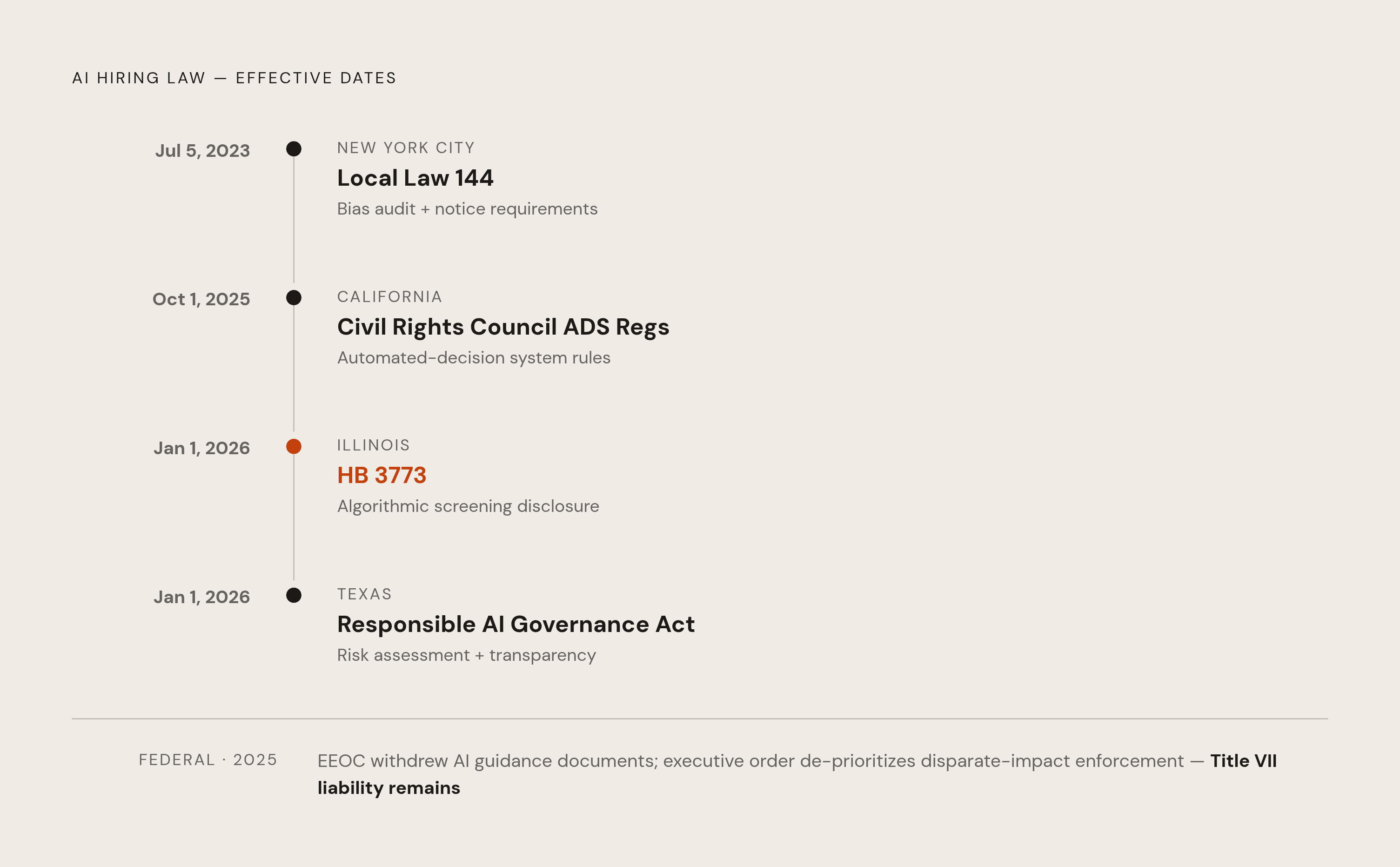
Four separate AI-hiring regimes are in force as of August 2026. New York City's Local Law 144 bias-audit rules have been enforced since July 5, 2023. California's Civil Rights Council automated-decision-system regulations took effect October 1, 2025. Illinois HB 3773 took effect January 1, 2026. Texas's Responsible AI Governance Act took effect that same date.
Federal enforcement has moved in the opposite direction. The EEOC removed its AI technical-assistance documents in 2025, and a recent executive order de-prioritizes disparate-impact enforcement at the federal level. That pullback doesn't erase the underlying law. Title VII's disparate-impact provisions remain enforceable by statute, and employer liability for adverse impact caused by automated screening tools hasn't gone away just because federal guidance has.
One point deserves particular attention from smaller teams: using a vendor's off-the-shelf AI screening tool doesn't transfer legal responsibility to that vendor. Startups and growth-stage companies using these tools remain accountable for what the tool actually does, regardless of who built it. The practical move before deploying any AI screening tool is to request bias audit results, explainability documentation, and contractual compliance commitments from the vendor directly. In a market already producing false negatives and false positives through ATS keyword matching, adding an unaudited AI layer on top only compounds the risk, both to candidates who deserve a fair look and to the company now legally on the hook for how that look is conducted. AI is now embedded in a majority of hiring processes, but the teams getting the strongest outcomes are those using it to extend human judgment rather than replace it, especially for craft-intensive roles like UX where portfolio review and taste cannot be reduced to pattern-matching.