Design Title Inflation and What Seniority Levels Actually Signal
Hiring managers must look beyond inflated titles to evaluate actual scope, ambition, and influence.

Design title inflation has made seniority harder to read from a résumé. The label no longer reliably tells a hiring team what someone can own, decide, or change. Hiring well therefore means looking beneath the title at the scope of a candidate’s work, the ambiguity they have navigated, and the influence they have exercised, then judging those signals against a shared definition of the role.
Why design titles have stopped functioning as reliable signals
A hiring manager screening for “Senior Designer” can encounter candidates whose responsibilities range from running one feature to owning an entire product organization. The same label can cover very different levels of budget authority and decision ownership. That leaves the hiring manager trying to compare people without knowing what the comparison rests on. The title appears to answer a question about seniority, but often only postpones it.
This is not simply a startup quirk or an accident of individual managers. Title inflation is a structural feature of the labor market, with several reasons for companies to keep producing it. Flat organizations have few rungs to climb, so someone on a team of three may get a senior title with no junior tier below them. Companies also give people higher titles to make them feel their careers are moving forward without promising them a pay rise. Startups can make the same trade when recruiting, offering a “Lead” or “Senior” designation to candidates they cannot afford at market rate.
These pressures loosen the connection between the label and the work. A title may reflect genuine responsibility, but it may also reflect the company’s structure or its need to retain someone. The person’s work is still worth just as much. It does mean that the label cannot do the whole job of distinguishing levels.
How the same title maps to fundamentally different jobs across org types
Part of the confusion begins with two separate questions being folded into one title. Specialty describes the domain someone works in, including product design, content design, user research, design ops, and graphic design. Seniority describes the level at which they operate within that domain. Knowing the specialty helps show which work fits the role, but it does not show how much responsibility the person had. The two axes need to stay separate if a comparison is to mean anything.
Above mid-level, another distinction matters because the ladder forks into individual contributor and management tracks. The individual contributor track includes Senior, Lead, Staff, and Principal, while the management track includes Manager, Director, and VP. These tracks are designed to offer equivalent levels of seniority and pay without requiring every experienced designer to become a manager. A Staff Designer and a Design Manager may therefore operate at the same level, even though one leads through influence and the other through reporting lines. Treating management as the only evidence of advancement misreads the purpose of the fork.
A “Senior” title from a 20-person startup and the same title from a large enterprise do not describe the same job by default. One role may combine broad responsibility with direct decision authority, while another sits within a narrower remit and more layers of approval. Neither setting proves a higher level on its own. The useful comparison concerns scope, autonomy, and influence within the organization.
What scope, autonomy, and influence actually look like at each design level
Design levels differ in what someone owns and how much direction they need to own it. Junior or early designers do tasks that are clearly laid out, with someone guiding them closely. Their responsibility centers on components rather than decisions, and they seek direction when the work becomes unclear. Mid-level designers can own the tasks they are given from start to finish with little help and produce solid designs for their projects. They follow design system patterns, know what the product needs from a feature, and talk with cross-functional peers without yet leading those conversations.
Senior designers have that same ownership across projects within a team. They know how features work together and help decide where the product should go beyond the next feature. Their autonomy includes presenting and defending design decisions, negotiating trade-offs, and facilitating conversations across functions. They can act as a design authority, mentor others, and uphold the team’s design quality. They exercise judgment about the work and help others reach decisions.
At Staff or Principal level, the radius of influence expands across multiple teams or an entire domain. Their impact comes from getting people aligned, making decisions, and helping others do their work, as well as from their own craft. This is the defining shift at the senior-to-staff bar. A designer’s own output can remain strong without showing that they can improve the direction of work beyond their immediate team. Higher-level evaluation therefore has to look at what others were able to do because of that person’s involvement.
Ambiguity makes these differences particularly visible. A mid-level designer asks for help when the direction is unclear, a senior designer is an authority when things are uncertain, and a staff-level designer makes things clearer for others. For management roles, who someone reports to is a useful first clue. A Design Director reporting to the CEO is more likely to carry director-level responsibility than one reporting to a VP who reports to a Senior VP. In either track, the higher-level value is judgment about what to build and why, a distinction that becomes more important as AI takes over more mechanical execution.
Why title-based screening systematically misses strong designers and lets weaker ones through
Once those differences are visible, the weakness of a title filter becomes clear. It admits candidates whose labels suggest the required level even when their work does not demonstrate it. A “Senior Designer” from a small startup where everyone is called senior might have a polished portfolio without ever having owned a project through ambiguity. They may never have helped set the direction beyond the scope they were given. The title still gets them into the interview loop because the filter treats the claim as evidence.
The filter can also turn away someone whose work is at a higher level than their title suggests. A person called “Designer” or “Mid-level” at a large organization may have carried an entire product surface, mentored peers, and driven cross-functional alignment. Their title may reflect a conservative ladder. If that label ends the evaluation, the work is never considered. This is the false negative that title-based screening makes easy to miss.
Startup titles are not always generous, and enterprise titles are not always restrained. People in the same title band can have different powers to make decisions, with some making the call and others asking someone above them to approve it. Screening tools built around title, employer brand, and years of experience encode that mismatch. They favor a résumé that resembles seniority over evidence that demonstrates it. The damage is asymmetric because false positives consume interview time and can produce bad hires, while false negatives disappear without anyone seeing the builder who was passed over.
How to read past a design title to what a candidate has actually owned
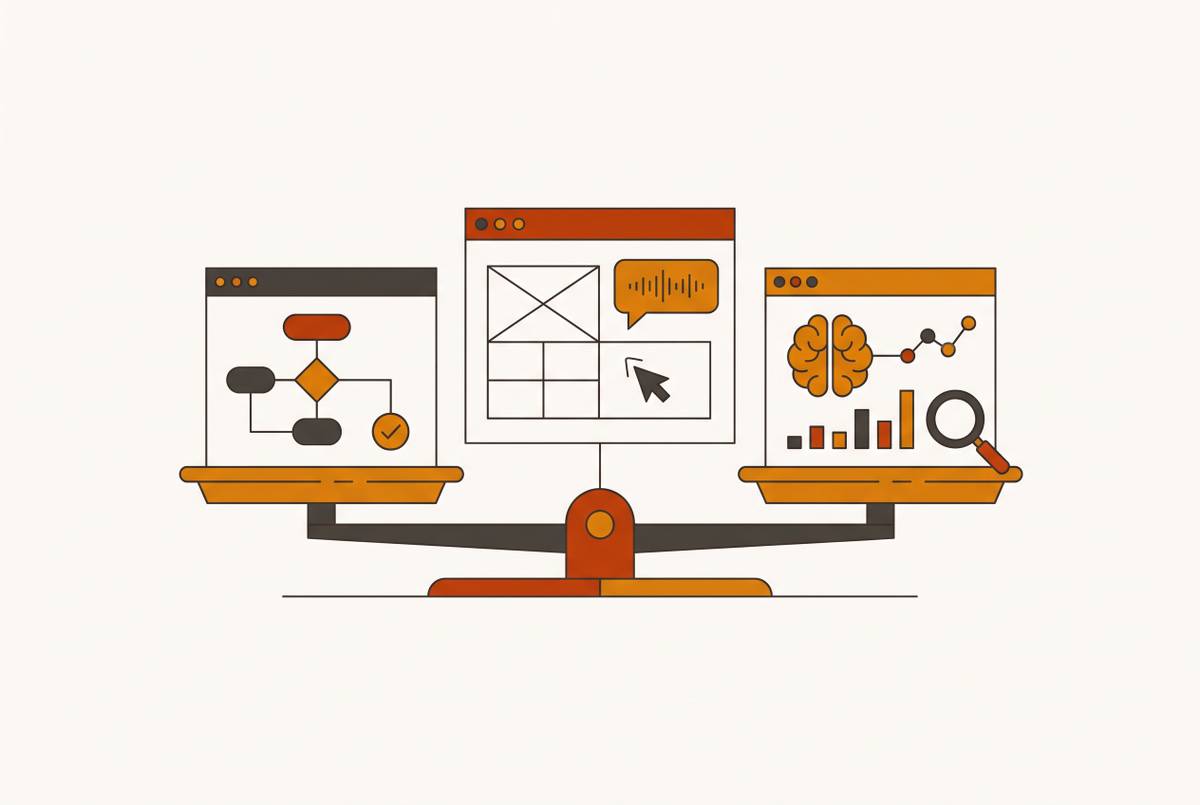
A structured evaluation of ownership, ambiguity, and influence can take the place of a title filter. These are subjects to explore in an interview. A candidate’s account of one project can reveal how the three connect, provided the discussion moves past the finished design to the decisions behind it. The aim is to establish what responsibility belonged to the candidate and what belonged to the people around them. That boundary is often more informative than the scale of the project itself.
Start with scope by asking the candidate to describe the full surface they were responsible for, whether it was a component, a feature, a product area, or a system. Then ask who else could have made the key design decisions and when those people deferred to the candidate. This separates being involved in a large project from owning its direction. Ask whether the candidate defined the problem as well as solved it, or received a brief from someone else.
Next, talk through a time when the right direction was truly unclear. Ask what the candidate did, whom they involved, and which decisions they could make without approval. The aim is to understand whether they needed direction, exercised judgment within uncertainty, or made the situation clearer for everyone else, recognizing that senior work also requires negotiation and cross-functional alignment. A discussion of a product or engineering decision they challenged can then reveal the basis of that judgment and whether it changed the outcome.
To distinguish senior from staff-level impact, move beyond the immediate project. Ask how the candidate’s work shaped the direction of other designers or teams, as well as what they changed about how people worked. This directs attention to influence rather than the amount of work they personally delivered. Place the account in context by asking whom they reported to, how many layers sat above that person, and how the design team divided its work. A “Lead Designer” on a three-person team and one in a 40-person design organization need that context before their responsibilities can be compared.
Portfolio discussion should return to what shipped, what changed as a result, and what would have been different without the candidate’s involvement. The polish of the case study is not the same thing as the quality of the decision it documents. Reading the work this way connects the visible artifact to ownership, autonomy, and impact. Those signals have always distinguished levels. Titles have stopped surfacing them reliably, so the hiring process has to go one layer deeper.
Why calibrating what "senior" means internally is a prerequisite for hiring it reliably externally
Better candidate evidence cannot resolve a disagreement about what the team is hiring for. If one interviewer expects someone to own a project on their own and another expects them to influence multiple teams, they are judging people for different roles with the same name. Candidates then get mixed signals, feedback is hard to square, and decisions take longer or fail to hold up afterward. The missing step is internal calibration before sourcing begins. Defining “Senior” for this company, team, and product context has to precede the job description.
A calibration sprint gives that work a focused setting. The hiring manager, a functional lead, and the consistent interviewers use the intake session to agree on what the role actually requires. They need to describe strong ownership in this specific job, the ambiguity the person will face in the early months, and the influence needed from day one. They also need to distinguish those starting requirements from responsibilities the person can grow into. That produces a shared standard against which the interview evidence can be read.
The session must also pressure-test the assumed level against the market. If the team calls the role senior but expects staff-level scope, sourcing at senior compensation creates a mismatch before interviews begin. Renaming the expectation does not reduce the responsibility being asked for. Calibration makes that contradiction visible while the team can still align the role and its hiring terms. It prevents the company from repeating internally the same title confusion it is trying to decode externally.
A unified system can capture the calibration as a living standard, with changes to the hiring bar made explicit and human-approved. People still need to use their judgment and build relationships, including deciding what counts as exceptional for this team at this stage and being there for the final call. A design title can still name the role. It cannot replace agreement about the work or evidence that a candidate can do it.