Contract-to-Hire vs Direct Hire for Early UX Roles
Contract-to-hire lets you test UX judgment before committing full salary to an undefined standard.
For most functions, the contract-versus-direct-hire question turns on a test you can run. For early UX roles, the test itself is the problem. The thing you are trying to evaluate, which is UX judgment, is also the thing you have not yet defined for your own product, and that makes the decision structurally harder than it is for engineering or sales.
An engineering candidate can be evaluated against a known codebase. A sales candidate gets tested against a quota, and the number either moves or it doesn't. Those standards exist before the hire. UX judgment doesn't work that way. The same designer who makes sharp calls on a consumer onboarding flow may flounder on an internal tool for compliance teams.
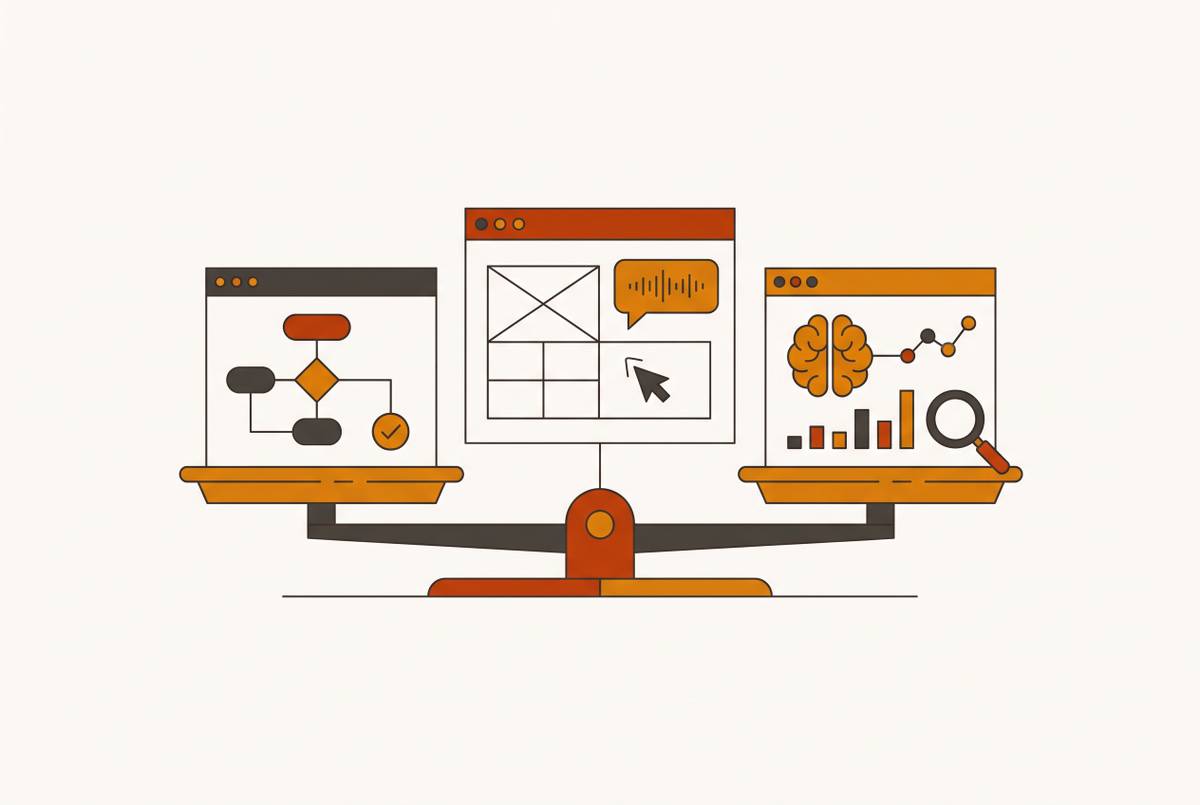
Part of the difficulty is that a UX job description can name all the expected artifacts without ever specifying what good judgment looks like. Wireframes, flows, research decks, these are things a candidate produces. But the role description rarely captures the judgment calls underneath them. Which user problem deserves a week of research and which deserves a quick guess? When should a design push back on an engineering constraint? When should it fold to one? Those questions are where the value lives, and they are almost never written down.
Add AI to the mix and the problem deepens. Tools have made artifact production cheap. Wireframes, layout variations, UI options, these are no longer scarce, and a candidate who can produce polished deliverables fast is now indistinguishable from one who simply has good tooling. The standard interview process was built for a world where craft was the signal. That world is ending. What remains is judgment, and judgment is exactly what a portfolio doesn't show you.
Contract staffing, in general, works well when the scope is clear. The challenge with early UX is that scope is rarely clear. So the model that seems like a low-commitment way in can turn out to be a way of postponing the real work without ever making it easier.
What each model actually commits you to, and what it does not
It helps to be precise about what each model does, because the difference between them is not mainly a difference in cost. It is a difference in where risk sits, who owns the outcome, and when you make your commitment. Direct hire puts a candidate on your payroll as a permanent employee from day one. The commitment is made before any real-world performance data exists. You are betting on an interview process, a portfolio, and a series of structured conversations, and the moment those end, the full cost begins.
Contract-to-hire works differently. How they collaborate with an engineer who disagrees with their recommendation. How they handle the fourth round of stakeholder feedback on a flow they thought was finished.
The cost structure differs in shape, not just amount. Direct hire carries a one-time agency placement fee, with entry-level roles near the low end of the fee range and senior or specialist roles toward the high end. But the exit is cheaper if the fit is wrong, and that asymmetry is the real point.
Neither model skips the calibration problem. Both require you to source, evaluate, and close a candidate. Both require you to know what you're looking for, or at least to be learning it. The commitment timing is the variable. Everything else follows from that.
What the UX talent market actually looks like when you go to hire
Market reality shapes which model is viable, and the UX market has a specific shape that complicates the decision. It is not short on candidates. It is short on the kind of candidate early-stage teams actually need.
The supply of aspiring UX professionals has outpaced open roles, especially at junior and entry levels. The roles that exist increasingly demand breadth, compressing what was once spread across multiple specialists into a single position. A team that would have hired a researcher, an interaction designer, and a visual designer a decade ago now wants one person who can do all three and also reason about the product.
That creates a real tension. They prefer the certainty of a permanent offer. So the structure that would let you observe actual work before committing is also the structure that filters out some of the strongest people you want to observe.
The second tension around market reality is that direct hire is still the overwhelming default. Data from more than 8,000 roles sourced between September 2025 and September 2026 shows the vast majority of roles with a named employment type were full-time or permanent, with contract-to-hire as a small fraction. That doesn't mean it's right for every situation. It means the candidate pool has been shaped by that norm, and candidates have come to expect it.
Neither model is a free lunch. Market reality pushes one way, information quality pushes the other. The decision that matters is which constraint you can bear.
Why calibration — not risk tolerance — is the real decision variable for early UX hiring
The contract-versus-direct-hire decision for early UX is not about how much risk a founder is willing to absorb. It is about whether the team can define what exceptional UX judgment looks like for their specific product before they commit. That is the variable, and everything else is downstream of it.
A job description is a poor proxy for this. When "exceptional" is undefined, direct hire front-loads the commitment before the team has the information to make it well. The full salary, benefits, and cultural integration begin before any real-world performance data exists.
Contract-to-hire, by contrast, allows a team to observe actual work product, collaboration style, and technical capabilities in real scenarios. The team sees how they think, not just what they made. That is the information direct hire can't provide.
The calibration problem is especially acute in UX because the signals hiring teams rely on are often wrong. It is not evidence of judgment under fire. It is evidence of storytelling ability.
Systems like Lantern treat taste as a learnable standard and pressure-test it against real market examples, and that matters here because taste is what needs pinning down. The problem is not that a founder lacks a sense of what good design is. The problem is that the sense is implicit, and a hiring process built on implicit standards degrades quickly once multiple people are involved.
There is a common objection to contract-to-hire: "We move fast; we cannot afford a six-month trial." A failed hire means another search, lost context, rework on whatever the person produced, and a damaged team dynamic. A structured contract period that surfaces a problem early is cheaper, in time, than discovering that problem twelve months into a permanent employment relationship.
The good news is that this is not a permanent state. The calibration gap closes, and the decision becomes easier. The challenge is only acute the first time, and a few times after that.
When contract-to-hire is the more defensible choice for an early UX role
Contract-to-hire is the more defensible model when a team cannot yet answer the question "what does great UX judgment look like for us" with specificity, or when the role itself is still being defined. That is a condition, not a preference. The clearest case is the first UX hire at a company. The contract period generates that standard. It gives the team the experience of working with a designer before they have any internal reference for what working with a designer should feel like.
A related case is a newly created or significantly redefined role, or a role tied to a new product line or market. The candidate may find themselves doing something different from what they accepted. The team may find itself paying for skill sets the actual work doesn't need.
Contract-to-hire also makes sense for roles where technical or judgment-based capabilities are genuinely hard to assess in interviews. Research-heavy positions are a good example. So are roles that require systems thinking across design and product, or roles where the candidate's collaboration style with engineering matters as much as their craft. These are exactly the qualities that only show up in real work over time.
When the roadmap has meaningful uncertainty, contract staffing provides capacity aligned to a shipping schedule without locking in headcount before the plan stabilizes. That is a legitimate use case, though it's different from the calibration argument. In that case, contract-to-hire is solving for flexibility, not information.
There is a practical condition that makes all of this work. Using "contract" as a euphemism for indefinite deferral demotivates strong candidates and wastes the period. The model only generates the standard it's meant to generate if the team is paying attention.
When direct hire is the right call despite the calibration challenge
Direct hire earns its premium under a specific set of conditions. It is not simply the default. It's the stronger choice when the team already has a clear and defensible definition of the role, or when the candidate pool will not accept a trial structure.
The clearest case is a team that has already hired and evaluated one or more UX practitioners. That team has a working standard. A second UX hire is different from a first, because the team has observed what works in its own product context. The information gap that makes contract-to-hire valuable has already narrowed.
Senior leadership positions fall into the direct hire category for a different reason. The market reality overrides the calibration benefit. For these roles, direct hire is appropriate not because the team is certain about the hire, but because no trial structure will be accepted.
Specific judgment comes from observing real work, and some roles are critical enough that turnover is itself a serious cost. Permanent employees develop institutional memory and relationships across departments that contractors rarely can. For roles where that matters, direct hire is the right trade.
Speed can also be the genuine constraint. In a competitive talent market, a strong candidate with a competing offer may not wait through a contract-to-hire conversation. The team that can't afford to lose them to a slower process makes the direct commitment.
Growth-stage teams with stable roadmaps and established UX practices lean toward direct hire for critical roles. The long-term cost advantage of permanent employment compounds over tenure, and a stable roadmap means the scope won't shift under the new hire. The calibration risk is lower because the team has hired before and knows what to screen for.
How the screening and evaluation process differs between the two models — and where each one breaks down
Choosing the right model does not solve the evaluation problem. Both models still require a screening process capable of distinguishing genuine UX judgment from polished presentation. Each model has a specific failure mode when that screening is weak.
Contract-to-hire's failure mode is different. It emerges when the contract period is treated as passive observation rather than active calibration. The period generates no usable information because no one defined what information they were looking for. For UX specifically, portfolio reviews and case study presentations are necessary but not sufficient. A work sample or brief design challenge anchored to a real product problem gives more signal than a portfolio walk-through, because it tests how the candidate reasons through ambiguity, not how they document decisions they already made.
What a well-run early UX search looks like in practice, and where AI hiring tools change the equation
The biggest operational gap for early-stage teams is not sourcing candidates. The traditional stack fragments this. Each step is a potential calibration loss, and by the time a candidate reaches the person who actually knows the role, the original standard has been filtered through several layers of approximation. Agentic recruiting tools in 2026 go beyond individual features to handle multi-step workflows. Scheduling automation, the most broadly scaled AI category in recruiting, eliminates coordination overhead that adds meaningful time to the hiring loop on lean teams.
Lantern is built for exactly this situation. A founder or HR leader describes what exceptional looks like in a fifteen-minute calibration session. Lantern pressure-tests that standard against the real talent market, then runs the full hiring loop: outbound and inbound sourcing, AI interviews, technical assessments, candidate engagement, and scheduling. What comes back is candidates worth meeting, with evidence of their actual work attached. Taste, market intelligence, and execution live in one system, so the calibration set at the start does not degrade by the time a candidate reaches the hiring manager. Every change to the hiring standard is visible and human-approved, which matters when the definition of exceptional UX is still being sharpened.
Other tools have taken pieces of this. Greenhouse added a Job Kickoff Agent and a Candidate Insights Agent to help hiring managers summarize scorecards, which is useful for teams already on that ATS. These help, but they operate within the handoff structure rather than removing it.
A practical decision guide: matching the hiring model to your UX stage and calibration readiness
The right model is determined by two variables in combination: how well you can define exceptional UX judgment for your product right now, and what the candidate profile you need will actually accept. Locate yourself on those two axes and the answer follows. If you cannot yet define exceptional with specificity, and the role is new or evolving, contract-to-hire is the more defensible choice. Define what you're watching for before the candidate starts, not after. If you have a working definition, meaning you have hired UX before and can articulate what made that person effective, and the role is senior or the candidate has competing offers, direct hire is the right call. A work sample anchored to a real product problem will outperform a portfolio review.
The stage transition to watch is the moment contract-to-hire stops being the right default. A real sense of what separates exceptional from competent in this specific product context. That is the asset that makes every subsequent hire easier, and it is worth investing in directly.
Regardless of model, invest in calibration before the search begins. If you can't yet, the first hire's job is to help you learn it. That reality, more than any preference for speed or caution, determines which model actually serves you.