Non-Obvious UX Candidates Screened Out by ATS Keyword Filters
Rigid keyword filters miss unconventional paths to strong UX skills.
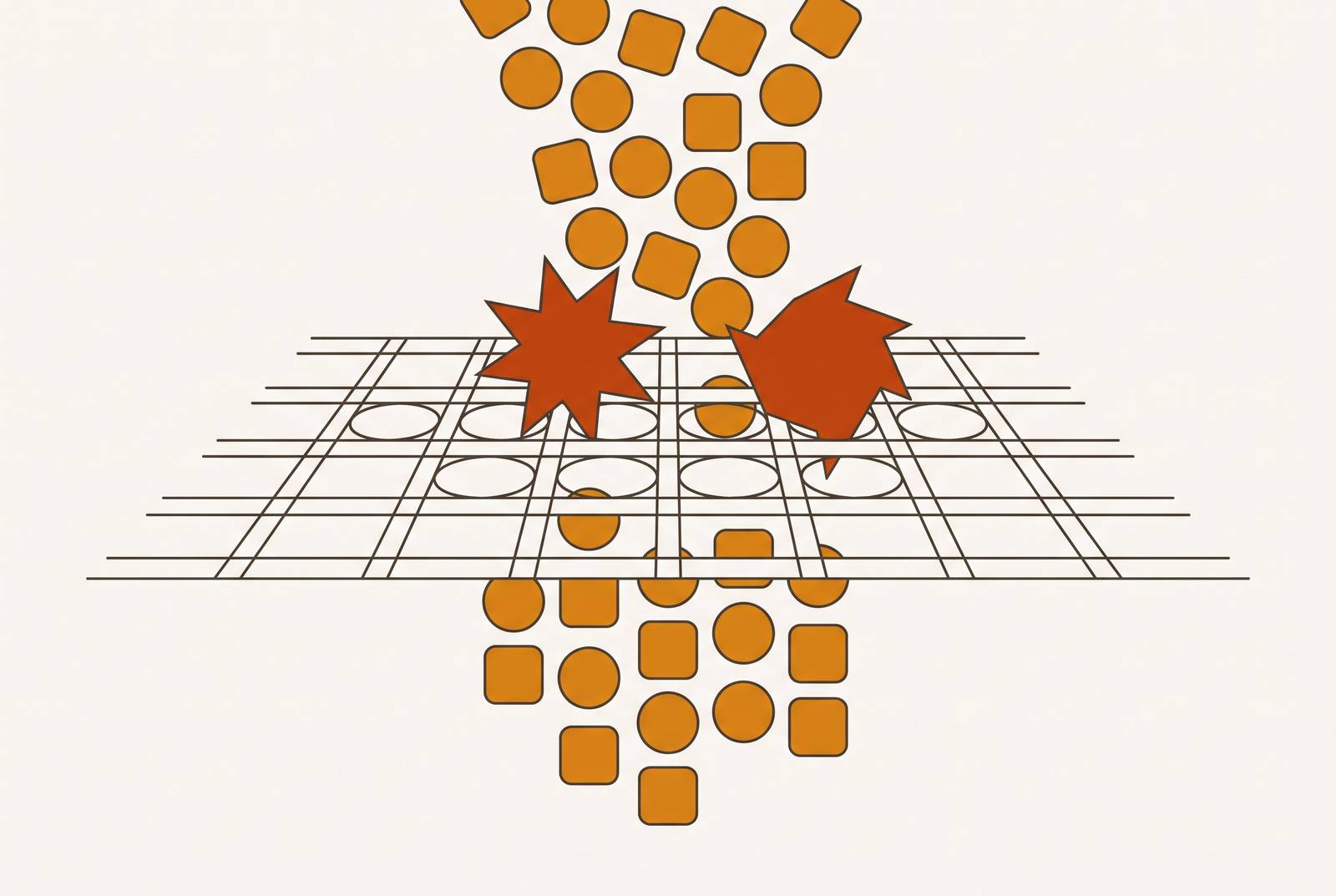
An applicant tracking system takes a resume, a messy, unstructured document, and turns it into structured data: fields, tags, categories a computer can search. Once that conversion happens, the system checks the data against keyword rules a recruiter wrote ahead of time. That part matters. The ATS doesn't decide anything on its own. It follows the rules it was given, precisely, which means a flawed rule produces a flawed result every single time, with no judgment layer to catch the mistake.
Two kinds of matching do the work here. Exact matching looks for a literal string: the resume either says "SQL" or it doesn't. Semantic matching tries to catch related terms, so "database management" might register as close enough to "SQL" to count. Many systems today blend both approaches. Smaller or older platforms often still lean on exact matching alone, which leaves less room for a candidate who describes the same skill a different way.
Deel's recruiter guide spells out the intended design: the system ranks and filters candidates rather than rejecting them. That distinction sounds reassuring until you follow it to its logical end. A candidate ranked near the bottom of a long list never gets opened by a human reviewer, so the practical result looks exactly like a rejection, even though no one technically rejected anyone.
The keywords themselves fall into a handful of buckets: hard skills, job titles and seniority levels, certifications, tools and platforms, industry terms. That structure assumes a candidate's value appears in the vocabulary of their resume. For a candidate with a recognized professional certification and a job title that matches the posting word for word, that assumption mostly holds. For a UX practitioner whose path runs through psychology research or newsroom product work, it starts to fall apart. That gap didn't appear by accident.
Why a surge in application volume pushed employers toward filters that are now too rigid
Application volume exploded between 2021 and 2024. Recruiters who once reviewed a few dozen resumes per opening suddenly faced hundreds, sometimes well beyond that, for a single role. Tightening the filters felt like the only sane response. Nobody can read eight hundred resumes by hand, so narrowing the funnel upstream looked like good triage.
The tool employers reached for was the binary knockout gate: a yes-or-no filter question that either passes a candidate through or drops them immediately. One poorly worded gate question can eliminate a huge share of a pipeline before a human reviewer ever opens a single resume. That's the appeal. It's fast. But what if, in solving for speed, the filter quietly discarded the exact candidates the role needed most? Speed and quality are not the same thing, and a rule built to shrink a stack quickly isn't the same as a rule built to find the right person.
eSkill's analysis, built on interviews with recruiting practitioners at Creative Evolutions, captures the underlying issue well: "AI operates on best practice. It operates on the most common way, because that's what it knows, unless you tell it specifically not to." That diagnosis doesn't only apply to AI tools layered on top of hiring systems. It applies just as much to the keyword rules recruiters wrote by hand long before AI entered the conversation. A filter built around the most common resume pattern will always reward the most common resume pattern, and punish anything that deviates from it, no matter how capable the candidate behind it might be.
So the tightening was reasonable. Given the volume, it's hard to call it careless. But reasonable responses to the wrong problem still produce the wrong outcome, and that's where the UX hiring breakdown really starts.
What the filter measures
An ATS keyword filter measures one thing: how closely a resume's vocabulary matches the vocabulary of the job description. That's the entire mechanism. It cannot measure skill, judgment, or output directly. It can only measure word overlap, and it assumes word overlap is a reasonable stand-in for capability.
For some roles, that assumption is close enough. For UX roles, it breaks down fast, because UX capability isn't built from one discipline with one vocabulary: it's assembled from psychology, journalism, front-end engineering, cognitive science, and content strategy, each with its own language for describing the same underlying skill. A job posting might ask for "usability testing" while a highly qualified candidate's resume says "user validation," describing identical work. The filter sees two different strings and treats them as two different things. One might argue the fix is simple, just tell candidates to match the posting's exact words. But that puts the burden on the applicant to guess the recruiter's phrasing, which is a strange way to evaluate design judgment.
Consider the career paths that actually produce strong UX practitioners. A former journalist who spent years building user-facing editorial products understands audience behavior at a level most design bootcamp graduates never reach. A cognitive scientist who ran behavioral studies understands how people actually make decisions, not how a style guide assumes they do. A front-end engineer who led accessibility audits understands the technical constraints UX decisions live inside. None of these resumes contain the phrase "UX Designer." None of them list Figma as a primary skill. A keyword filter built around standard design-title language has no way to recognize any of them.
Keywords do not capture the qualities that separate an exceptional UX practitioner from an average one. Whether a feature should exist in the first place, before spending a single hour designing how it looks. The ability to act as a product partner rather than someone who just produces deliverables on request. The capacity to take behavioral research and turn it into a specific interaction decision. None of that fits into a resume field. A filter built to count matching words has no mechanism for detecting any of it, because it was never asked to.
How resume parsing failures add a second layer of exclusion on top of keyword mismatch
Keyword mismatch isn't even the first hurdle. Before any matching logic runs, the resume has to be parsed correctly: the system has to correctly read the document and sort its contents into the right fields. That step fails more often than most hiring teams realize, and it fails silently. A skill listed in a sidebar, a job title formatted in an unusual font, a date range split across two columns: any of these can get dropped, misread, or shoved into the wrong field.
When that happens, the candidate gets scored against information that was never actually recorded, even though it existed on the page they submitted. They look less qualified than they are, through no fault of their own and with no way to know it happened.
UX candidates run into this constantly, because they tend to present their work through formats that are harder to parse: portfolio links, case study PDFs, resumes built with visual structure instead of plain text. Those are exactly the formats most likely to confuse a parser built around conventional, single-column resume layouts.
On top of the mismatched vocabulary, resumes that fail to parse correctly make the picture worse. A UX candidate whose resume uses different terminology than the posting, whose layout partially fails to parse, and whose portfolio evidence lands in the wrong field is fighting three separate, independent exclusion mechanisms before a recruiter ever lays eyes on their application. Fixing the keyword vocabulary alone wouldn't solve this. The document itself has to survive the parsing step first, and that's a separate failure point.
How the AI resume arms race makes the filter's output less reliable, not more
If the structural problem were static, it would at least be predictable. It isn't. Candidates now use AI tools to generate keyword-optimized resumes in seconds, and employers use AI-powered filters to sort the results. Both sides are escalating at once, and the effect is that the system increasingly rewards whoever is best at presenting themselves on paper, not whoever is best at doing the actual work.
eSkill's 2026 analysis documents the mechanics directly: candidates paste a job description into an AI tool and get a tailored resume back almost instantly. Some go further, using documented tactics like embedding the full job description in white text so the ATS reads a perfect keyword match even though a human reviewer would never see it. A practitioner interviewed in that same analysis described reviewing application after application where the submitted answers were nearly identical to each other and to the job posting itself. It's the predictable output of optimizing for keyword density rather than for substance, not a coincidence.
The candidates clearing AI-powered keyword filters are increasingly the candidates most skilled at gaming AI-powered keyword filters. That's a measure of resume-writing facility. It says nothing about design thinking, nothing about research skill, nothing about the judgment UX work actually requires.
For UX roles specifically, this inversion carries a real cost. A candidate who writes a persuasive, keyword-dense description of their design process is not necessarily the candidate who can sit across from a user, run an interview, and walk away with an insight that changes the direction of a product. The filter can't tell these two people apart, because it was never built to evaluate interview skill or research judgment. It was built to count words. The false positives it produces don't cost anything measurable during the week a requisition closes. They cost something months later, when a hire who interviewed well on paper struggles to do the work the role actually demands.
Why most hiring teams don't detect the failure until long after the damage is done
Almost no organization tracks whether the candidates who clear its keyword filters go on to perform well. Without that feedback loop, there's no signal telling anyone the screening logic is broken. The filter can be quietly wrong for years, and the data to prove it never gets collected.
Research from Harvard Business School and Accenture, on what researchers call "hidden workers," documents one half of this disconnect clearly: employers report serious difficulty filling open roles, while millions of qualified candidates submit applications and never hear back. Both groups describe the same hiring market, but neither side typically traces the mismatch back to how the filters were configured.
One check exists for catching this early. Skillfuel points to a metric called Precision@10: pull the top ten candidates an ATS surfaced for each of the last five closed requisitions, and count how many of them actually made it past the phone screen. A low score there points straight back to keyword gaps in the job description itself. Most hiring teams never run this check. There's no requirement to, and nothing in a standard hiring dashboard prompts anyone to ask the question.
A filter calibrated around credential patterns that produced hires in the past keeps rewarding those same patterns indefinitely, even after the role has changed, even after the market has shifted, even if the original link between credential and performance was never measured. Nothing forces a recalibration. The failure just continues, compounding quietly, invisible in every metric a hiring team is likely to check.
What screening for UX capability requires instead of keyword matching
Screening for UX capability means building the intake process around evidence of how someone thinks, not around whether their resume's word choices happen to match a job posting. What has this candidate shipped? What did they question before they started building it? What broke along the way, and what did they do once it did? These are the questions that actually predict UX performance, and a keyword-ranked resume doesn't capture any of them.
Apple's Tim Cook has described screening explicitly for traits that don't show up on paper: collaboration, curiosity, creativity, and expertise. A shipped application, a working design system, a complex project carried from start to finish, each of these tells a hiring team more than any credential list could. The work itself becomes the evidence.
For UX roles specifically, the intake question that should replace keyword matching looks something like this: what has this person actually built, what assumptions did they question before they built it, and what does their process reveal about how they handle uncertainty? A portfolio case study can answer all three. A resume formatted to match a job posting's word choices can answer none of them.
This doesn't require abandoning structure. It requires shifting what the structure measures. Deel's recruiter guide makes a related point about keyword design generally: an outcome-based keyword, something like "shipped a design system used by a ten-person engineering team," says more about actual capability than a line reading "Figma proficiency" ever could. The lesson scales beyond keyword wording. Any screening process built around outcomes and evidence of thinking will catch more of the right candidates than one built around vocabulary overlap, because outcomes are harder to fake and harder to game.
Where human judgment remains irreplaceable in UX candidate evaluation
Automation has a real job in hiring: handling volume. What it cannot do, and was never built to do, is exercise taste. Recognizing capability in a candidate who doesn't describe themselves using the right vocabulary takes a human reviewer paying close attention, and that function has been slowly engineered out of the process by filters that make taste feel unnecessary.
HeroHunt's 2026 recruiter guide frames this division of labor clearly: AI tools deliver the most value when they absorb volume and repetition, while humans stay responsible for nuance, empathy, and the final call. Aptitude Research's analysis backs this up from the recruiter's side, finding a strong preference among recruiters to keep final decision authority rather than hand it to an algorithm. The consensus across both: automation should shrink the pile a human has to review, not replace the judgment that happens once it's in front of them.
For UX hiring, the judgment call matters most exactly where the candidates are least obvious. The cognitive scientist whose resume reads like a research CV. The journalist whose portfolio tells a product story instead of a design story. The front-end engineer whose code commits reveal sharper interaction thinking than their job title ever would. A recruiter with calibrated taste for UX work recognizes these profiles for what they are. A keyword filter rejects every one of them, because none of them were built to be legible to a filter.
Calibration is what makes that taste repeatable instead of accidental: building a shared, explicit, written-down standard for what strong UX work looks like at a specific company, for a specific product. Without that standard, every reviewer applies a different implicit bar, and the non-obvious candidate loses out more often than not, simply because nobody agreed in advance on what to look for. The fix isn't removing automation from the process but putting it back in its correct place: compressing volume at the top of the funnel, while human judgment, backed by calibrated standards and real work samples, decides who's actually worth a conversation. A hiring process that treats taste as something that can be documented, reviewed, and applied consistently across reviewers stops the filter from rewarding credential pattern-matching over actual capability.