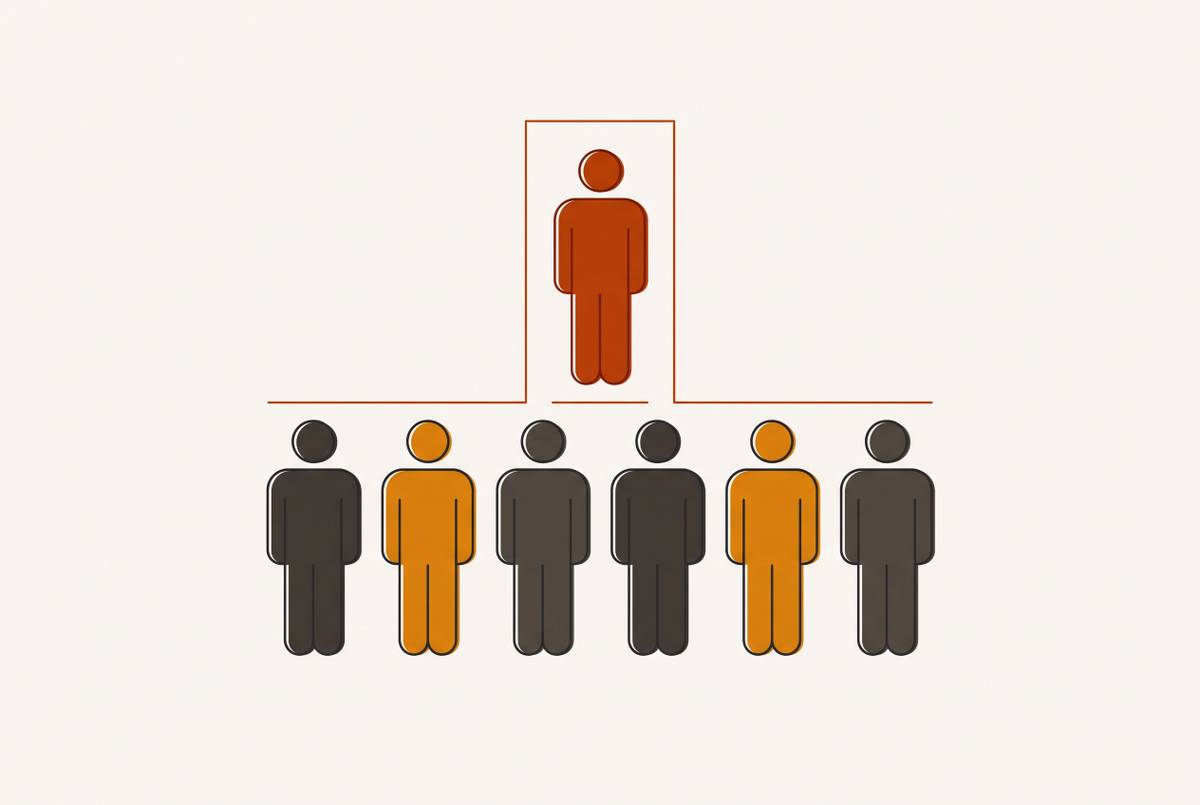
How Exceptional Differs by Company Stage
Hiring standards shift at each company stage, but most teams fail to recalibrate them.

What calibration means and why most teams skip it
"Exceptional" isn't one fixed quality a company finds or fails to find. It shifts by stage, and most hiring teams get this backwards: they treat the bar as constant, borrow it from somewhere else, and pay for that mistake the moment the new hire actually starts working. A founder copies the hiring bar from Google. An investor points to a portfolio company's best hire and says "get me someone like that." A job description borrows language from a company three funding rounds ahead. None of that is calibration. It's imitation, and imitation gets punished fast.
The candidate who would have been transformative at seed becomes a liability at Series B because the job changed to something the person did not. Most hiring failures are calibration failures. The company chased a signal that belonged to a different set of constraints, a different headcount, a different set of problems.
Calibration, in a hiring context, means something specific. It's a structured session where the people doing the hiring sit down together, review candidate profiles side by side, and argue out their disagreements before the search opens. They agree on what a strong answer to a given interview question actually looks like, and they write it down. Skipping that step means one interviewer walks away calling a candidate exceptional while another calls the same person mediocre. The process turns into a subjective lottery dressed up as rigor.
Most teams open a search before anyone has agreed on what good looks like, so the job description ends up doing the work a real definition of fit should be doing. Title, employer brand, resume polish become stand-ins for judgment because they're fast to check. They also screen for the wrong things, especially in a company's early years, when the job itself barely resembles the title on the posting.
Research has found that structured interviews outperform unstructured ones at predicting job performance, roughly by a factor of two. But structure alone doesn't save a bad outcome. A perfectly run, perfectly documented process still produces the wrong hire if the underlying definition of exceptional was borrowed from a stage the company hasn't reached yet. Calibration is the mechanism. What it encodes has to change as the company changes, and most teams never revisit it. Calibration is the actual failure.
Seed stage: hiring to prove the bet, not to scale it
At seed, the company hasn't proven much of anything yet. The team is still testing assumptions, talking to users constantly, changing direction when the data says to. The first ten or fifteen hires aren't just filling roles. Whether anyone planned it that way or not, they're setting the operating culture the rest of the company inherits.
Range beats depth here, and this is where a lot of seed-stage searches go wrong by hiring for depth anyway. Someone who can own three different functions and switch between them by Thursday afternoon is worth more than a specialist who's mastered one narrow lane. Tolerance for ambiguity matters just as much. Candidates who've only worked inside companies with existing systems, existing playbooks, existing org charts, tend to struggle badly once none of that exists yet. There's nothing to plug into, and no one coming to build it for them.
Culture fit isn't a soft, secondary consideration at this stage, and treating it as secondary is the mistake to avoid. Unusual Ventures makes the point directly: looking for culture fit doesn't mean settling for a technically weaker candidate. The two carry equal weight. Skills get taught on the job. Passion is a lot harder to install after the fact, and nearly impossible to fake past month three.
A false positive occurs when a resume looks perfect on paper and the person is wrong for the job anyway, because the company needs someone who'll build the thing with their own hands, and the candidate is expecting a staffed department to manage. That pattern shows up repeatedly in early-stage searches. Side projects, something built from zero to one, and informal leadership nobody assigned predict performance in ways a resume doesn't.
The risk carries different weight on each side. A wrong hire at seed dilutes the founding culture and burns through runway the company doesn't have much of to spare, with no larger organization around it to absorb the damage. At a larger company, a bad VP hire is painful but survivable. At a 10-person company, the organization has far less capacity to absorb that kind of damage.
Series A: the builder who can also install the scaffolding
Something shifts at Series A. Product-market fit appears in the data, the team needs to grow past its founding core, and the company needs repeatable process without turning into a bureaucracy overnight. That's a narrow needle to thread, and most searches miss on one side or the other, usually by hiring someone built for the wrong side of it.
Hager Executive Search draws a sharp line here: at Series A, the company needs someone who has built a 200-person organization from scratch, specifically someone who's lived through the climb from 10 to 50 people, not someone who inherited an organization already that size. Running an established machine and building one from scratch call on completely different muscles, and mistaking one for the other is the single most common Series A hiring error.
Hands-on matters more than ever. A candidate who shows up expecting a fully built department, existing systems, an established team, fails even with flawless credentials on paper. The company doesn't have any of that yet. Building it is the entire point of the role.
The most common mistake at this stage is hiring for aspiration: bringing in someone whose experience matches where the company wants to be in three years, not where it stands today. That mistake gets punished at scale. Leadership hires mismatched against the company's current reality rather than its aspiration contribute meaningfully to the failure rate among startups that don't make it past Series A.
So what should calibration encode here? Evidence of having built a function from nothing. Comfort doing the actual work before managing anyone else doing it. Real tolerance for ambiguity, past the word "ambiguity" typed into a posting. Take two candidates: one built a scalable sales motion inside a 15-person company from scratch, the other holds a VP title at a much larger, mature organization. The first often outperforms the second in this specific role, but keyword-and-credential screening surfaces the VP first anyway, because the VP's resume pattern-matches to "success" even when the pattern doesn't fit the job on offer.
Series B and beyond: raising the bar without importing the wrong model
By Series B, the model is proven. The job now is scaling it, and the bar for talent has to rise, even though the company's internal scaffolding still isn't anywhere close to enterprise-grade. That mismatch, rising expectations against unfinished infrastructure, is where a lot of otherwise strong hires quietly fail.
Exceptional at this stage means leaders who can operate with real autonomy and own a function end to end, executing more than tasks handed down from someone else. Operational discipline becomes a hard requirement rather than a nice-to-have. SaaS companies heading into 2026 have largely moved away from the growth-at-all-costs instincts that defined 2020 and 2021, shifting instead toward profitable growth. That shift calls for a different kind of leader than the one who thrived when capital was cheap and burn rate barely mattered. The ability to build and manage a team, not just be the smartest individual contributor in the room, decides success here more directly than at any earlier stage.
The pedigree trap gets specific at Series B: the VP from a large tech company, with the perfect-looking resume, is not the right hire for a 25-person company. Full stop. It doesn't matter how impressive the name looks in a board deck, or how good it feels to tell investors who just joined.
Calibration should encode proof of scaling a function, not just running one that already existed, evidence of building teams under real resource constraints, and explicit alignment with the company's stance on profitability versus growth. A leadership mismatch doesn't correct itself along the way. It compounds quietly if the calibration standard doesn't move with the company. The failure mode looks identical at every stage: someone imported a definition of exceptional from outside the company's actual, current context.
How growth trajectory and learning agility factor in across all stages
Stage-specific calibration carries its own risk. Lean too hard into "what does this stage need right now," and a hiring team ends up over-indexing on current skills while ignoring how fast someone actually learns. That's the correction most calibration sessions never make, and skipping it is arguably a bigger mistake than getting the stage-fit wrong.
Growth trajectory tends to outweigh current capability over the long run, for a scaling startup at pretty much any stage. A candidate with moderate skills today but strong learning agility usually contributes more twelve months out than a candidate who's stronger right now but shows little sign of developing further. Does that cancel out everything said above about stage fit? Not exactly. Learning agility in the wrong environment still produces a bad outcome. A high-agility generalist at seed and a high-agility functional leader at Series B are solving two entirely different problems, even if both score well on the same "agility" dimension on paper.
So what's the practical fix? Calibration sessions should score growth trajectory as its own dimension, alongside role-specific skills, used consistently rather than pulled out only when two candidates look otherwise equal. Only 37% of employers consider credentials and learning history reliable indicators of future capability. Most employers already weigh trajectory above pedigree when judging candidates; their process just hasn't caught up. Skills-based hiring is one structural response: companies running skills-based searches consistently improve hire quality by surfacing trajectory over credential. The mechanism isn't mysterious. Skills assessments reveal trajectory. Credentials bury it.
Where the talent market pushes back on stage-specific hiring plans
None of this happens in a vacuum. BLS JOLTS data has shown roughly 7.6 million open jobs against somewhere around 5.1 to 5.2 million actual hires. Constrained hiring is the baseline, not the exception, and any stage-specific plan has to be built assuming that constraint rather than hoping around it.
Speed compounds the problem. Time-to-hire has stretched significantly across 2025 and 2026, but the strongest candidates rarely sit around waiting that long, they're gone in a fraction of that window. A large share of the global workforce falls into the passive category: people who aren't actively job hunting but would move for the right opportunity. Most of the people worth hiring aren't even looking. Sitting back and waiting for inbound applications, for a stage-specific executive search, means fishing in the wrong pond.
Compensation has to be calibrated to stage too, not to aspiration. Benchmarking salary and equity against comparable companies at the same stage, not against where the company hopes to be in two years, keeps the offer competitive without overcommitting cash or equity the company can't spare. A disciplined search approach maps where the strongest operators actually sit, by stage, by function, by leadership background, before a search even opens. That mapping does double duty: it pressure-tests whether the calibrated definition of exceptional is something the real market can supply, or whether the hiring plan itself needs adjusting before week one ends. Catch that gap early. Catching it at the offer stage, after six weeks and a recruiter's fee are already spent, costs a lot more than catching it on day one.
Why AI screening tools systematically miss stage-fit candidates
Most screening tools are built to recognize credentials, and that's exactly where they go wrong. They're good at surfacing resumes that pattern-match to a job description. Pattern-matching to a job description usually means encoding the wrong definition of exceptional from the start, especially outside of later-stage hiring where credentials actually do carry signal.
InCruiter's research found that semantic search surfaces roughly 60% more relevant profiles than traditional Boolean keyword search, and cuts false-positive rates by about 62%. The same research found that around 40% of viable mid- and junior-level candidates come from sources traditional applicant tracking systems never surface. Natural language processing adds another layer of correction. AI trained on real career patterns can catch something a keyword search never would, like the fact that a lot of top-performing product leaders spent early years in customer-facing roles before moving into product. Search "product leader" with keywords, and none of those people show up.
There's a fraud layer sitting on top of all this, and it's getting worse. Research suggests a significant share of candidates have meaningfully inflated their resumes, and AI-assisted applications are making it harder than ever to separate genuine capability from surface presentation. Polished credentials get less trustworthy by the year, which raises the real cost of leaning on them too heavily.
Stage fit doesn't live in a resume, not really. The seed-stage builder who spent three years at a 12-person company nobody's heard of carries no recognizable brand name. A credential-pattern tool ranks that person below a Series B executive every time, even when the builder is the better fit for the job actually open. Fixing this means configuring the tool around the stage-specific definition the company already worked out. Calibration comes first. Calibration comes first, and sourcing and screening logic follow it.
Keeping the definition of exceptional current as the company moves through stages
A quieter failure mode occurs after a company has already hired well once: the definition of exceptional that worked at seed gets carried forward, unexamined, into Series A and then Series B. The cultural values that made those first hires great slowly calcify into hiring criteria that no longer match the job in front of them.
Every change to a hiring standard should be visible and reasoned, something a person actually decided on purpose, rather than a drift that happens quietly because of whoever ran the last search or what the last successful hire happened to look like. Calibration works best as a living process, revisited at every stage transition, with each round of interview feedback sharpening the definition instead of just confirming whatever assumptions were already baked in.
Research has found that a large share of employees are unaware of internal opportunities at their own organization, an internal blind spot companies rarely name, let alone fix. As a company moves through stages, someone correctly passed over for a role eighteen months ago might be exactly right for a role that exists now and didn't back then. A static definition of exceptional never finds that person, because it was never built to look.
AI can run parts of this process well: surfacing candidates, flagging mismatches between resume and role, catching patterns a human eye would miss at scale. But the final call still belongs to a human who understands the company's real situation, not a model's best guess at it, because the decision comes down to whether a specific person fits what the company needs right now. The companies that hire well across every stage treat their definition of exceptional as something alive: tested against what the market can actually deliver, rewritten every time the company itself changes shape.