SOC 2 Type II Certified AI Hiring Platforms for Design Teams
Type II audits prove hiring platforms controlled candidate data over time, not just at one moment.

AI hiring platforms for design teams handle more than résumés. They hold portfolios, interview recordings, and judgments that help decide who gets hired. SOC 2 Type II is the meaningful trust benchmark because it tests whether controls worked over time. But trusting a platform also means reading the report’s scope and checking what the audit cannot promise about AI judgment.
Why SOC 2 Type II is the meaningful trust bar for AI hiring platforms — not Type I
Type I and Type II answer different questions, rather than represent two tiers of the same assurance. Type I establishes that controls existed at a particular point in time. Type II tests how controls operated over an audit period. For a live hiring workflow, that difference separates evidence of a control’s existence from evidence of its sustained use.
An AI platform keeps processing candidate data after audit day, so the difference matters. Its outputs are not necessarily the same on every run, and its behavior can drift as it processes new data. Type I can establish a starting point, but it cannot describe the months when candidates were submitting work and receiving assessments. Type II provides evidence about that operating period, within the boundaries of what the auditor tested.
What a design-team hiring workflow actually sends through a platform
Consider a designer submitting a case study about an unreleased product. That file now lives on a vendor’s server, and its contents may belong partly to a previous employer. The platform is holding more than evidence of the candidate’s skill. It may also hold visual assets and product work that a third party expects to remain confidential.
The usual record is still there, with names, contact details, and employment history. AI interviews add video and audio recordings that can show protected characteristics, signs of health issues, and how a person feels. A recording is therefore not just a more convenient version of a written answer. Sharing it for review extends the question of who should have access.
The platform also generates data of its own, including scores, ranking signals, and inferred skill evaluations. Those outputs inform consequential decisions, so they need to be traceable and auditable. Hiring managers then contribute notes, feedback, and preferences that define what their team considers exceptional. These calibration inputs are comments that hold the company’s own hiring knowledge. They should not leave the platform’s controlled environment to train shared models.
Personal information raises questions about how it is collected and used, while portfolio files raise questions about confidentiality. Scores raise questions about processing, and candidates need to be able to use the platform when their assessments are scheduled. An audit must cover what goes through the workflow as well as the fact that the vendor stores data.
How each SOC 2 criterion maps to the data risks in design hiring
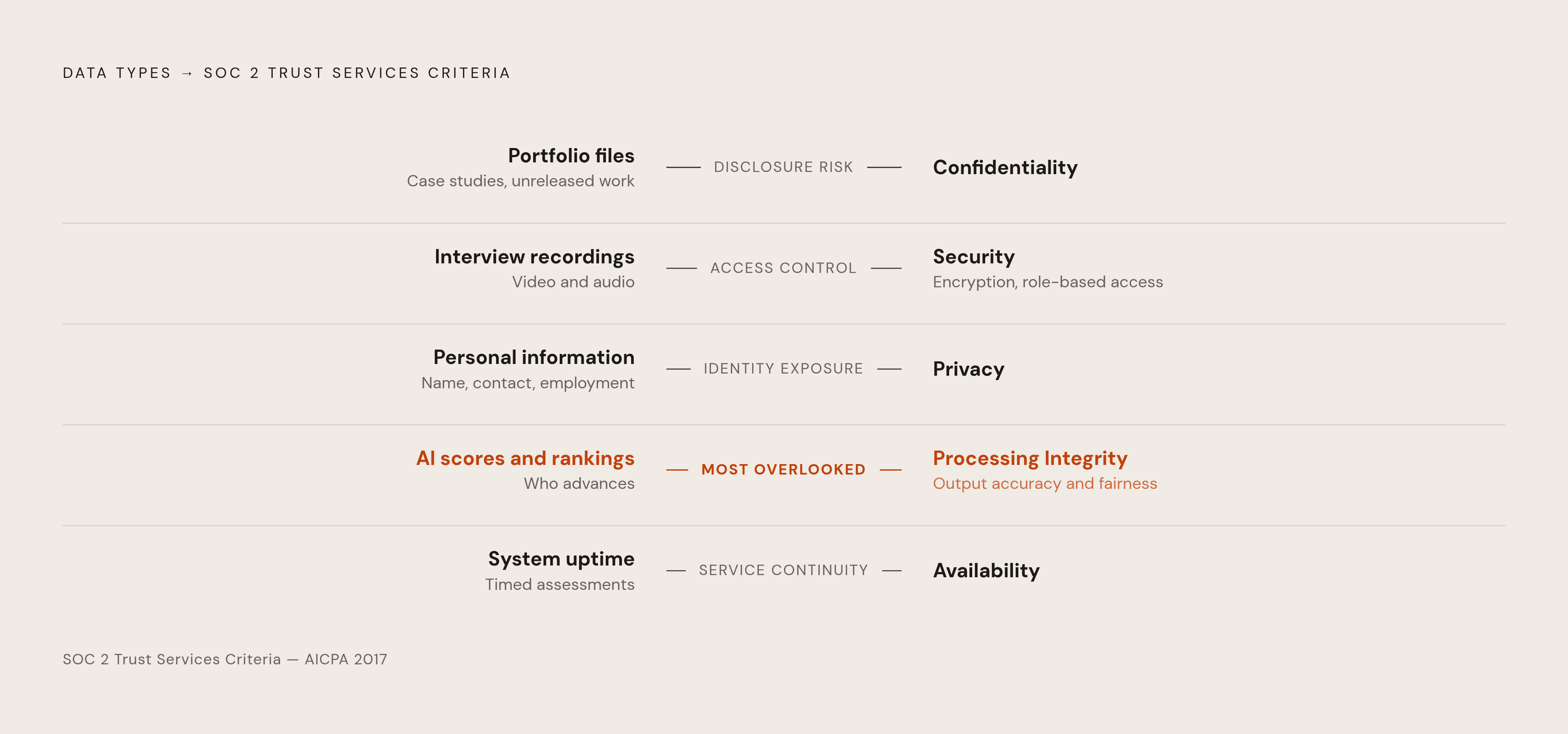
Security is the only mandatory SOC 2 Trust Services Criterion. It covers the basic defenses around candidate materials, including access management, encryption in transit and at rest, and incident response. For recorded interviews, buyers should ask whether audio and video are encrypted end-to-end and whether role-based access limits who can watch them. A shareable link sent to a remote hiring manager is a particular attack surface, and where a Type II audit tests shareable-link encryption, it provides evidence that this control operated during the audit period.
Confidentiality addresses information designated as confidential, which makes it directly relevant to an unreleased product case study. Auditors examine whether the platform has documented what counts as confidential, how it protects that information, and when it deletes it. The distinction is important because keeping intruders out does not answer every question about a portfolio file. The platform must also have rules for handling the material entrusted to it. Those rules matter to both the candidate and any previous employer whose work appears in the submission.
Privacy covers how personal information is collected, used, kept, and disposed of. It applies to the candidate’s name and employment history, but the underlying issue is broader than protecting a contact record. The platform makes commitments about what it does with personal information. A Type II report covering Privacy provides evidence of whether it consistently honored its own privacy notice over the period examined. That is a different assurance from merely showing that a notice existed.
Processing Integrity covers whether processing is complete, valid, accurate, and done on time. In design hiring, this connects directly to the scores and rankings used to decide who advances. Inconsistent re-ranking of candidates from the same inputs raises a processing-integrity concern, while bias and drift can be visible in the behavior of scoring outputs. The important boundary is that testing processing controls does not, by itself, establish that a model judges design skill fairly. That broader question remains even when the processing meets its stated requirements.
Availability covers whether people can access the system as promised. It may sound less sensitive than confidentiality, but an outage during a live AI interview or time-boxed assessment cannot be cleanly undone. The candidate’s assessment experience is part of the workflow being protected. Buyers should therefore examine which criteria the report includes and how long the audit covered them. For this use case, Security alone is narrow assurance, and reports should include Confidentiality and Privacy at minimum, plus Processing Integrity when AI-scored outputs inform hiring decisions.
Why the regulatory environment makes Type II verification non-negotiable, not optional
The case for sustained controls also comes from laws already in force. These laws create separate obligations for legal compliance, and SOC 2 Type II’s value is evidence of documented controls operating over time. That makes verification a necessary part of a defensible vendor evaluation.
New York City Local Law 144 has been in force since 1 January 2023, with enforcement beginning 5 July 2023. Where an automated employment decision tool screens candidates for jobs located in NYC, the employer must commission an independent annual bias audit and publicly publish impact ratios by sex, race, and ethnicity. The job’s location is the relevant distinction, regardless of where a candidate lives. This bias audit is a separate obligation from SOC 2. Documented, auditable controls support the evidence it requires, but a Type II report does not satisfy the bias-audit requirement.
The California Civil Rights Council regulations on automated-decision-system use have been in force since 1 October 2025. Illinois HB 3773 and the Texas Responsible AI Governance Act have been in force since 1 January 2026. These regimes extend the AI-governance landscape beyond NYC. Their requirements should not be treated as interchangeable, but together they make reliance on a vendor’s general assurances harder to defend. A buyer needs both a description of how the platform was intended to operate and evidence of how it operates.
The EU AI Act adds a further distinction for international hiring. Its Annex III high-risk obligations for hiring systems have been deferred to a later compliance date than originally set. When those obligations arrive, they include risk assessments, technical documentation, bias testing, human oversight, transparency disclosures, and continuous monitoring. Separately, the ban on workplace emotion recognition involving employees or candidates has applied since February 2025, including reading “enthusiasm” from a video interview. Design teams using AI video analysis must check that the platform does not use emotion inference.
These obligations point toward sustained documentation, but they also show its limits. A Type II report covering Processing Integrity and Privacy is evidence about consistent control operation during the audit period. It is not a declaration that every hiring practice meets every applicable law. The useful role of the report is to make the vendor’s control claims examinable.
What to actually verify in a vendor's SOC 2 Type II report before trusting the badge
Start the vendor conversation with scope and period. The report should identify which criteria were examined and for how long. For a platform handling video interviews and AI-scored outputs, look for Security, Confidentiality, Privacy, and Processing Integrity at minimum. A badge does not tell a founder or HR leader whether all those areas were included. Reading the scope establishes what the rest of the report can actually support.
Next, read the description of the auditor’s tests and their results. Look for explicit testing of video encryption, access controls on recordings, retention and deletion, and AI output consistency. The tests need to address the data your workflow sends through the platform. General statements about security do not settle the more specific question of who can view a recorded interview.
Then examine exceptions, where controls failed or were not consistently applied. An exception requires an explanation of remediation.
Compare the report’s Privacy coverage with the vendor’s data-use policy and contract. Verify a contractual commitment that candidate data and hiring-manager calibration inputs are never used to train shared AI models. Privacy coverage deals with how data can lawfully be used and kept, while the contract may contain the rule against training. Neither document should be assumed to answer for the other. Reading both prevents a broad assurance from obscuring a specific permission to reuse data.
Finally, verify the auditor’s independence. SOC 2 requires an independent licensed CPA firm. NYC Local Law 144 separately requires a bias auditor with no financial relationship to the automated employment decision tool’s developer.
How AI hiring platforms should handle training data, model drift, and human sign-off — and what SOC 2 alone does not guarantee
Even a well-scoped Type II report does not certify fair or well-calibrated hiring judgments. Processing Integrity concerns the accuracy and completeness of processing, but it does not require proof that scoring logic stays stable across time. A platform may change its effective criteria as it processes more data. Buyers should ask how the vendor detects and discloses drift.
Design hiring makes that distinction especially important. Keyword matching on a title or employer name can miss a designer whose strongest evidence appears in a portfolio, a GitHub repo, or a Behance case study. Conversely, AI-assisted application language can match a scoring system’s preferred patterns without demonstrating actual skill. The countermeasure is evidence-based evaluation through portfolio review and work-sample tasks. Buyers should check that the platform supports that approach, because a security audit cannot fix a weak definition of talent.
A shared model trained on hiring-manager feedback benefits from the company’s proprietary judgments and may carry those preferences into other employers’ searches. The contract must spell out that this use is banned. When scoring weights change for experience, portfolio quality, or specific tools, the change should be visible to the hiring team and require human sign-off before taking effect. When changes to who gets surfaced go unannounced, hiring becomes harder to audit even if access controls still work.
Candidates also need to understand when and how AI is involved. A substantial majority distrust AI evaluation, and those uncomfortable with AI interviews are likely to withdraw before completing the process. For design teams competing for a small pool of exceptional practitioners, opacity creates a risk of losing candidates before their work receives serious attention. Platforms should support clear disclosure rather than treat candidate understanding as separate from hiring quality.
The practical division of work is therefore clear. AI can handle sourcing, outreach, and first-pass screening under documented, audited controls. A human hiring manager is in charge of calibration, the final interview, and the decision on every offer. Type II establishes the operating evidence needed to trust the platform with sensitive work.