Interview Performance Theater in Technical Hiring
Whiteboard coding predicts interview performance, not job performance.
What the predictive validity gap means for hiring decisions
Most technical interviews measure how well someone prepared for the interview rather than their ability to do the job. Call it performance theater: a hiring ritual that looks rigorous on the surface but rewards rehearsal and interview-specific pattern recognition over the judgment the role actually requires. Difficulty was never the problem. Extracting the wrong signal is.
Whiteboard coding makes the case. A candidate stands at a whiteboard under fluorescent light, marker in hand, reciting a memorized version of the two-pointer technique while an interviewer nods along. What gets measured there is anxiety tolerance and algorithm recall. Not the ability to design a payments retry system, and not the ability to debug a memory leak in production at 2 a.m.
Most hiring managers say their process is thorough without hesitation when asked. Most hiring managers go quiet when asked if their process is predictive. Those are different questions, and only one of them matters. Predictive validity asks something narrow and unforgiving: how much of a candidate's actual on-the-job performance does the interview score explain?
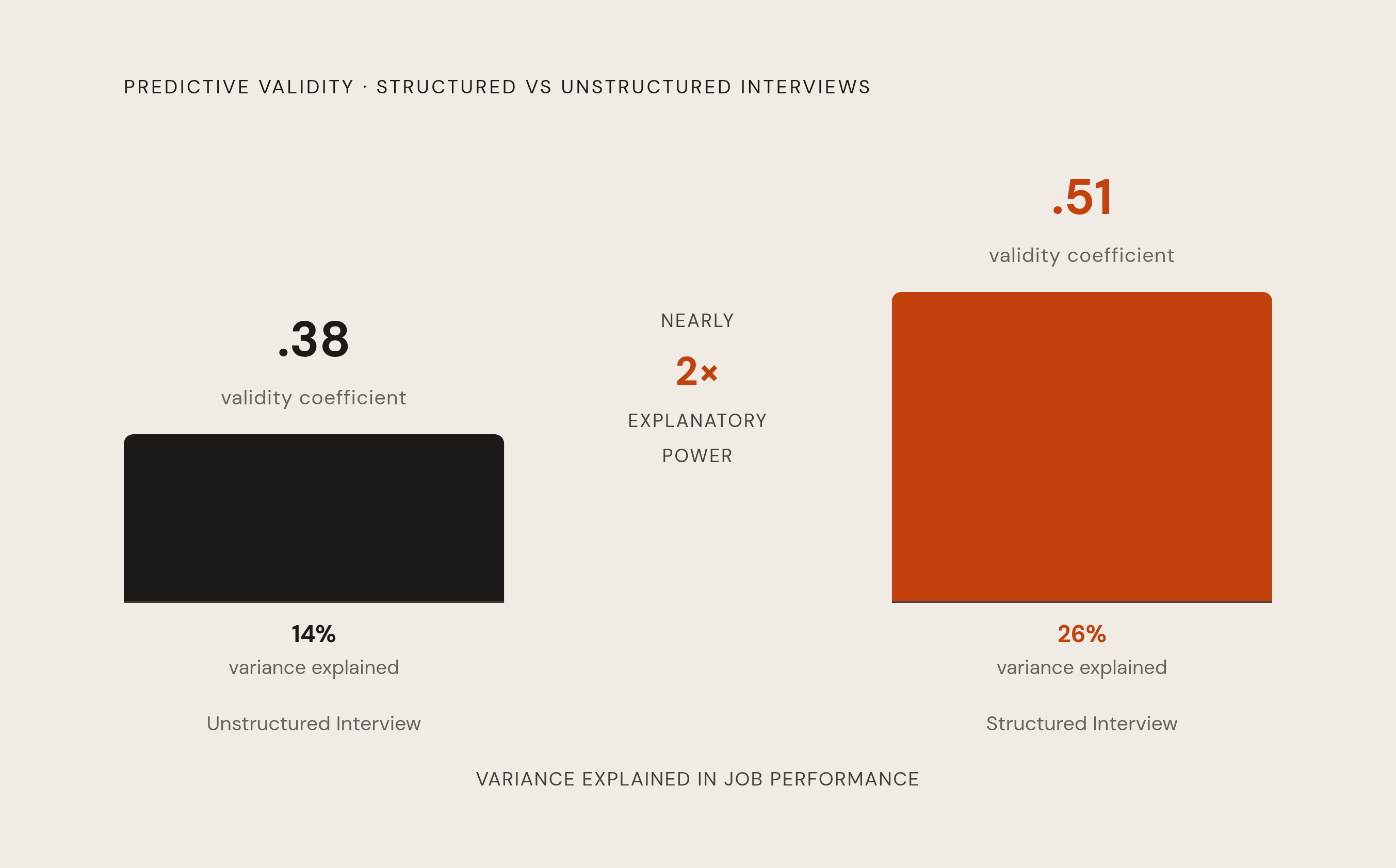
Schmidt and Hunter's meta-analysis is still the reference point here. Unstructured interviews, the kind where someone just talks to a candidate and forms an impression, predict job performance at a validity coefficient of.38. Structured interviews, with the same questions and the same scoring criteria applied to every candidate, hit.51. That jump looks modest until it gets converted into variance explained:.38 accounts for roughly 14% of what determines job performance,.51 accounts for roughly 26%. Structured interviewing nearly doubles the explanatory power. An unstructured interview leaves most of what actually predicts success unaccounted for, an expensive coin flip conducted under better lighting.
Two interviewers compared against each other agree even less. A meta-analysis covering 111 interrater reliability coefficients found unstructured interviews average an ICC of.37. Two people watching the same candidate answer the same questions agree with each other about a third of the time. A lab test that unreliable would never get ordered twice, let alone used as the basis for a diagnosis. Yet that's what most interview loops run on.
How the whiteboard era created the performance gap
Whiteboard coding wasn't always theater. There was a stretch when reciting an algorithm from memory was a fair stand-in for engineering competence, because the daily work actually involved building that logic from scratch under pressure. That era is closing, and two forces are pushing it out at once.
The first is AI coding assistants. When a tool produces a working red-black tree balancing routine in seconds, reciting one from memory in an interview stops measuring anything real. The job has moved toward reviewing, directing, and debugging generated code. That's a different skill than recalling syntax cold, and testing for the old skill tells you nothing about the new one.
The second force is evidence. Whiteboard performance predicts whiteboard performance. It doesn't reliably predict what happens six months in, when the candidate is untangling a production incident with no textbook in sight and no interviewer nodding along.
Companies with real engineering weight behind their hiring have already made the shift. Anthropic, Stripe, Vercel, and Linear lean on take-home projects, pair programming sessions, and live coding exercises built around scenarios that resemble the actual job. Skills-based hiring adoption climbed to roughly 85% of employers, up from 73% in 2023. The term still gets stretched loosely across companies, but the direction is unmistakable: away from the whiteboard, not back toward it.
The gaming problem: how candidates are defeating assessments from both sides
Once an interview becomes something to optimize rather than something to honestly attempt, gaming it becomes the rational move. It's the predictable output of a system that rewards rehearsal on the candidate's side. It's the predictable output of a system that rewards rehearsal: if the test rewards memorization, candidates memorize, and if memorization isn't enough, they reach for whatever tool closes the gap.
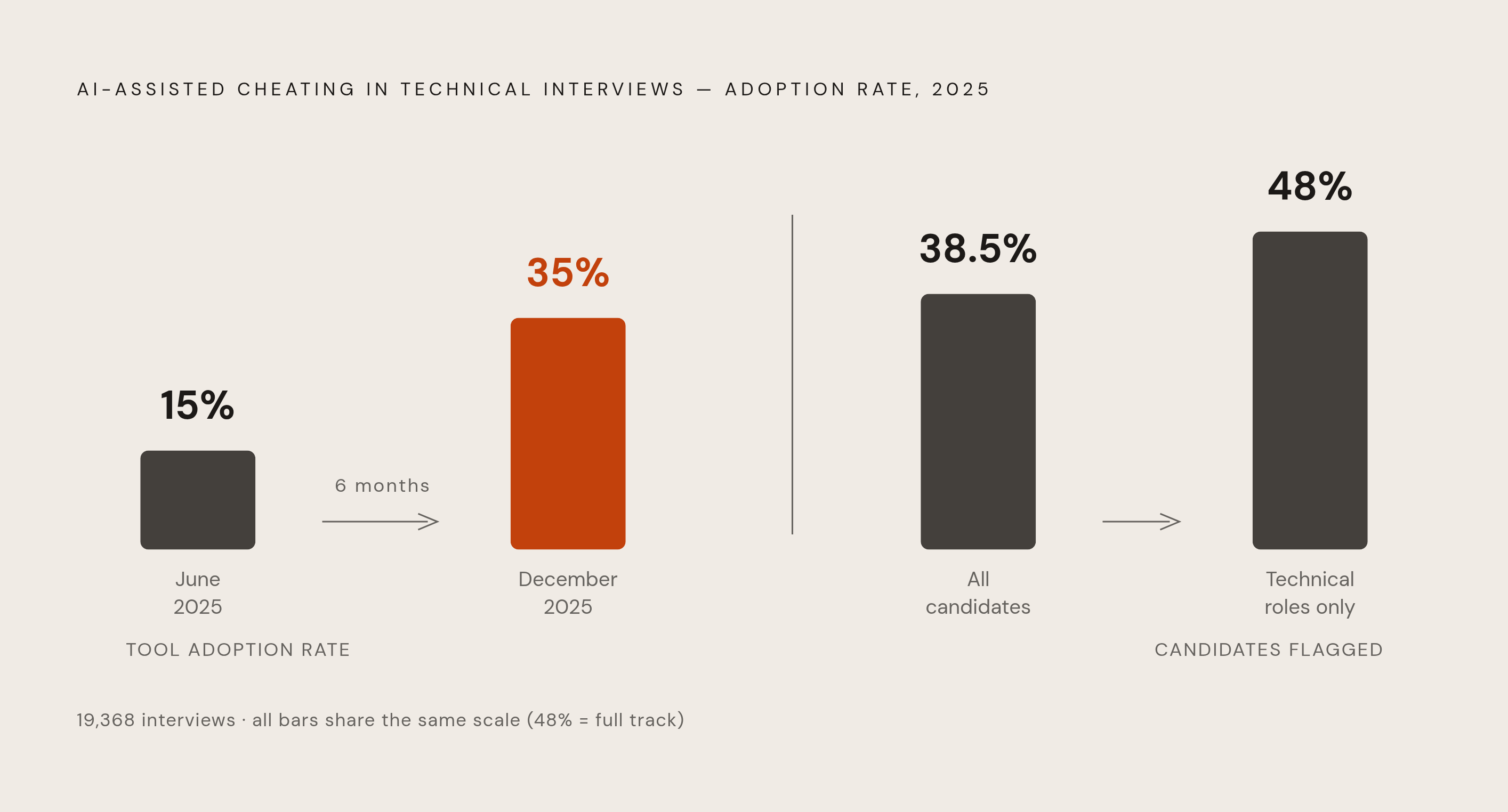
The scale stopped being a rounding error a while back. Across a sample of 19,368 interviews, 38.5% of tech candidates showed signs of AI assistance. In purely technical roles, that figure climbs to 48%, meaning close to half the technical candidates in that sample were getting real-time help they weren't supposed to have. Adoption of these tools more than doubled in six months, from 15% in June 2025 to 35% by December 2025. Whatever number describes the problem today is a floor, not a ceiling.
The mechanism explains why the old defenses stopped working. Certain cheating tools run invisible overlays rendered beneath the level standard screen-sharing software captures, so the recording never shows the overlay. Tab-switching alerts, browser lockouts, webcam monitoring: all of it was built to catch someone secretly opening a second browser tab. None of it was built for software designed to hide from the screen capture itself. The old detection layer solves a different, older problem: catching someone secretly opening a second browser tab. It's structurally irrelevant against this class of tool, built to solve a problem that no longer describes how candidates cheat.
What calibration is and why most teams mistake a scorecard for it
Calibration means interviewers agree, in advance and in practice, on what each score on a rubric represents and where the bar for "hire" actually sits. That's an alignment exercise between people. A scorecard is a shared form. Calibration is shared meaning, and mistaking one for the other is where most hiring processes quietly fail.
Two interviewers can fill out the identical rubric, rate the identical candidate, and land two points apart, because one interviewer's "4" and the other's "4" describe entirely different mental thresholds. The document was the same. The interpretation wasn't, and the document can't fix that on its own.
This isn't a hypothetical sitting in the tail of some distribution. One in three companies say they aren't confident in their own interview process, and one in two say they've lost a quality hire because of it. That's a structural weakness sitting in the middle of how hiring decisions get made, not an edge case.
Calibration also drifts on its own if nobody actively maintains it. A hiring manager under pressure to fill a seat lowers the bar without announcing the change to anyone. An interviewer who hasn't seen a genuinely exceptional candidate in months resets their internal reference point downward, so "good" starts to feel like "great." A flashy side project, impressive but irrelevant to the role, ends up outweighing a mediocre score in the one skill the job can't function without. None of this takes bad faith. It just takes a standard nobody's checking.
What rigorous technical evaluation looks like in practice
Four formats are widely associated with stronger predictive validity: work-sample exercises, structured behavioral interviews, live pair-programming sessions, and system-design discussions. That's not a coincidence of format. Each one earns its predictive power the same way: scored against a weighted rubric, tied to outcomes a team can point back to and defend.
Work samples deserve the closest look, since they come nearest to replicating the job itself. The task looks structurally like what the candidate will do on day one, and that changes the whole cheating conversation. If someone uses an AI coding assistant to complete a work sample, that's not automatically contamination. It might be exactly the skill under measurement, since that's how the work will actually get done once they're hired.
Structured behavioral interviews carry real value, but only paired with a calibrated rubric, and the three pieces control for different failures. Structure controls for interviewer drift, the tendency to wander off-script based on rapport or mood. The rubric controls for weighting, so strength in a nice-to-have area doesn't quietly outweigh a gap in a must-have one. Calibration controls for interpretation, so a "3" means the same thing across every interviewer using it. If any one of the three is pulled out, the other two can't cover for it.
None of this floats free of what candidates themselves find fair. 66% of developers say they prefer practical coding challenges over theoretical tests: the format that produces the most reliable signal is also the one candidates trust most. Rigor and fairness turned out to point in the same direction all along.
How market reality should constrain the hiring plan before interviews begin
Interview design doesn't happen in a vacuum. The labor market underneath it changes what's even possible before the first question gets asked, because it sets the pool of candidates and their leverage before an interview design can act on either. The quits rate, a reliable measure of how willing workers are to voluntarily leave a job, has been stuck at 2.0% for most of a year, reflecting a prolonged period of worker reluctance to leave their jobs. When people stop job-hopping, the pool of active applicants shrinks, and it doesn't shrink evenly: the strongest candidates, the ones with options, are usually the first to stop looking.
What does that mean for sourcing? Inbound applications skew toward people who need a job rather than people choosing between offers. Reaching someone who wasn't actively looking becomes the primary way to access real talent. Interview design and sourcing can't stay separate functions anymore. A well-built evaluation process aimed at a candidate pool that no longer contains the strongest candidates is solving the wrong problem, however well it's built.
Specialist domains complicate this further. In machine learning, security, and revenue operations, candidates are fielding multiple competing offers again, because demand still outpaces supply by a wide margin, and people in those fields know how much leverage that gives them. A significant wage premium now attaches to AI skills specifically. That's not a marginal adjustment to a salary band; it's a different market. A hiring plan still running on pre-2025 comp numbers will likely lose its target candidate before the interview loop even starts, no matter how well the loop itself is designed.
What changes when taste, market data, and evaluation live in the same system
Most hiring organizations run on a fragmented stack, and that fragmentation is the quiet cause behind most of the failures described above. Taste, the hiring manager's often unspoken sense of what "great" looks like, lives with the hiring manager. Market intelligence, what compensation and pipeline actually look like right now, lives with a sourcing tool. Evaluation lives with a recruiter running a process someone else designed. None of the three is available to the other two at the moment a decision actually gets made.
The handoffs between them are where things break. If a recruiter doesn't fully understand what the hiring manager values, calibration has already failed before a single interview gets scheduled, no matter how clean the rubric looks on paper. If sourcing runs disconnected from real market data, the target candidate profile is wrong before the first outreach message goes out. Each handoff degrades the signal a little, and those small losses compound into something much bigger than the sum of them.
A system that keeps taste, market data, and evaluation together works differently. It surfaces the hiring manager's actual, testable definition of exceptional, not a job description written to sound thorough, but a living standard checked against real evidence. It pressure-tests that standard against the actual talent market before a search even begins, so the bar being set is one the market can realistically clear. It runs outbound sourcing, interviews, and structured assessments against one consistent rubric, instead of three separate interpretations stacked on top of each other. It delivers candidates with evidence attached: what they built, how they performed, where they scored. And when the hiring standard changes, that change is visible and requires a human to sign off on it, so bar drift gets caught the moment it happens instead of six months later, buried inside a bad hire.
What doesn't change, and shouldn't, is where judgment sits. Deciding who to hire, and having the conversation that turns an offer into an accepted job, stays a human function. That's relationship and discernment, not process administration. The system's job is making sure that judgment works from real evidence, gathered consistently, against a standard everyone actually agrees on. Everything upstream of that decision is where performance theater lives. Everything downstream of it is where good hiring still depends on someone making a call.