When to Lock a Hiring Standard vs. Keep It Open
Calibrated hiring standards prevent costly miscues between locking too early and drifting too late.

The labor market has 6.9 million job openings chasing 4.8 million hires, according to BLS JOLTS data. That gap is not new, but it is doing something specific to hiring teams right now: it is pushing them toward two opposite failure modes at once. Lock the standard too early and the search filters out strong candidates the market hasn't surfaced yet. If the standard is left open too long, scope creep, hiring manager whims, and sheer exhaustion quietly redefine the role mid-search. Knowing which pressure you're under, and when the data actually justifies a change, is the discipline this piece is trying to unpack.
Add to that gap a flood of noise: applications are up 239% industry-wide, driven largely by AI tools that make it trivial to apply to dozens of roles in an afternoon, per testask.org. So a thin, weak-looking pipeline could mean the standard is wrong. Or it could mean the signal is garbage and the standard is fine. Telling those two things apart is getting harder, not easier.
Johnny Campbell, CEO of Social Talent, called the "low hire, low fire" pattern that defined 2025 "the new baseline." Not a blip. Not a correction that reverses itself next quarter. And teams are being asked to navigate this with fewer resources than usual: only 30% of companies expect their TA budgets to grow, and only 24% plan to add recruiter headcount. More applications, fewer reviewers, a tighter market. That combination is exactly the environment where hiring standards either calcify into bureaucracy or dissolve under pressure to just fill the seat already.
What a hiring standard is, and why most teams don't have one
A hiring standard is not a job description. A job description lists inputs: title, degree, years of experience. A standard defines outputs. It's a calibrated, shared answer to one question: what does exceptional actually look like for this role, at this company, right now?
Most teams don't have one. What they have is a job description and an assumption that everyone reading it means the same thing. Most teams don't have one; what they have is a job description and an assumption that everyone reading it means the same thing. When multiple interviewers each carry their own implicit definition of "good," hiring turns into a lottery. One interviewer walks away thinking a candidate was exceptional. Another interviewer, same candidate, same conversation topics, rates them mediocre. Nobody's lying. They're just scoring against different, unwritten rubrics, according to research from recruitbpm.com.
Job descriptions make this worse because they substitute familiar credentials for a real definition of fit. A title and a degree are easy to write down. They're also weak proxies for fit, because they describe where someone has been, not what they can actually do.
There's a useful distinction buried in how good recruiting teams run their intake process: an intake call and a calibration call are not the same meeting. Intake captures logistics, comp band, timeline, reporting structure. Calibration is where the panel agrees on what evidence of each criterion actually looks like, before anyone touches a real resume. Skipping calibration means skipping the part that makes the standard real.
This matters more, not less, as skills-based hiring spreads. Nearly 45% of companies in 2026 say they prioritize demonstrated skill over credentials, per klearskill.com. But "demonstrated skill" has to be defined before anyone can assess it. Skills-based hiring without a rigorous standard is just hiring on vibes with extra steps. It's just hiring on vibes with extra steps.
A real standard has two parts: the criteria, and the evidence that would satisfy each one. If evaluators miss either half, they aren't assessing fit. They're pattern-matching on whoever feels familiar.
So once a standard like that exists, the real question starts: how do you know when the evidence is telling you to change it, versus when the pressure to change it is just noise dressed up as data?
How to build a standard that is lockable
A standard is only worth locking if building it cost something. That sounds obvious, but it's the whole test.
Before the first real interview happens, the full hiring panel needs to sit down together, walk through the scorecard, and score a sample candidate profile as a group, according to guidance from testask.org. Disagreements need to surface here, on a practice run, not three weeks into live interviews when a strong candidate is sitting in the balance.
The mechanics matter too. A rubric where a score of 1 means "no evidence" and a score of 4 means "specific, concrete example demonstrated" gives interviewers something defensible to point to. Compare that to a five-point "gut feel" scale, where a 3 from one person and a 3 from another might describe entirely different candidates.
One principle from testask.org is worth repeating because it's the thing most panels get backwards: candidates should be scored against the benchmark, not against each other. Relative comparison is seductive, especially in a weak pool, because it always produces a "best" candidate. But the best candidate in a weak pool is not the same thing as a good hire. Relative comparison quietly inflates whoever looks strongest by default, which is a very different question from whether they clear the bar.
The interview-to-offer ratio is a diagnostic number worth tracking here too. A healthy benchmark is around 3:1, according to data from seekout.com. Climb past 4:1, and that's usually a sign too many borderline candidates are reaching final rounds, per seekout.com. Either way, this calibration problem appears as a funnel problem.
The calibration call is something bigger than a checkbox exercise: real alignment between recruiter and hiring team on what a strong candidate experience looks like from the first conversation to the offer. That's a higher bar than most intake calls clear.
Here's the payoff for all this upfront work: a standard built this way, scored, panel-aligned, anchored to concrete evidence, is worth locking because changing it later has a visible, traceable cost. A standard pulled together from a job description alone isn't worth locking, because nobody actually agreed to it in the first place, so there is no shared baseline to defend.
This is where AI systems earn their keep in hiring, when they're used well. The useful version doesn't replace the calibration conversation. It preserves the outcome of that conversation across every search, so the standard becomes the system's operating logic rather than a shared document someone wrote in January and never opened again.
When market feedback is a legitimate reason to adjust the standard
Only 31% of recruiting teams actively use labor market data to inform sourcing and hiring decisions, according to a Gartner HR research study. Only 31% of recruiting teams actively use labor market data to inform sourcing and hiring decisions, and the other 69% are deciding, essentially by feel, whether a thin pipeline means the standard is wrong or the search strategy is wrong. Those are very different diagnoses, and guessing wrong is expensive.
The distinction that actually matters: a thin pipeline caused by a bad search strategy looks identical, on the surface, to a thin pipeline caused by a standard that simply doesn't exist in the market at the offered comp. Same symptom. Different disease.
One way to separate the two is to think through the actual addressable pool: how many people qualify, how many are reachable, and how many fit the compensation band. Run the math and if the number comes back genuinely, structurally small, the standard probably isn't the problem. The search parameters are.
So what actually counts as legitimate market signal, strong enough to justify touching the standard? A few things:
The addressable pool at the current salary band is confirmed, through data, to be structurally too small, not just assumed to be small by one frustrated recruiter. Remote-work policy has shrunk the pool further than expected: 55% of remote-capable employees now work hybrid and 26% work fully remote, so a fully on-site requirement can eliminate a meaningful share of otherwise qualified candidates, according to talentmsh.com. Adjacent role analysis shows the actual skill exists in the market under a different job title, so the standard might be right but the search profile is aimed at the wrong label. And late-stage offer rejections keep clustering around comp, which is the market bluntly telling you the salary band doesn't match what the standard demands.
For roles that move fast or matter strategically, refreshing market intelligence regularly makes sense, and a major event, a wave of layoffs in the sector, a sudden RTO policy shift, justifies pulling that refresh forward.
But here's the discipline that actually separates good calibration from panic: market data justifies adjusting search parameters, where you're looking, how the role is titled, what it pays, before it justifies touching the standard itself. Exhaust those levers first. Only after that does the standard become the right thing to question.
When interview evidence is a legitimate reason to adjust the standard
One strong candidate who doesn't fit the standard proves almost nothing. A consistent pattern across multiple searches proves something entirely different. The hard part is not confusing the two.
What does a real pattern look like? A few signals recur repeatedly in the data and are worth trusting:
Candidates who otherwise perform well keep missing on the exact same dimension, over and over, across different searches. That's not a coincidence. It usually means the criterion is defined in a way that doesn't match how the actual skill appears in the real world. Interview-to-offer ratios stay stubbornly above 4:1, which points toward too many borderline candidates reaching final rounds and a genuine mismatch between the standard and the pool, per seekout.com. And post-hire performance data starts contradicting what screening predicted. If 12-month retention slips past a 15% threshold, per seekout.com, something in the standard, the screening, or the onboarding isn't matching reality.
The feedback loop is what makes any of this systematic instead of anecdotal. Every interview rating should feed back into the calibration process. AI systems that sharpen a standard with each cycle of feedback make this repeatable, rather than dependent on whether the one person who remembers last quarter's misses happens to still be in the room.
Standards evolve for good reasons too, not just bad ones. Some technical hiring teams have shifted toward requiring candidates to solve real-world problems, rather than the traditional whiteboard algorithm test. That's not lowering the bar. That's raising it, based on evidence about what actually predicts success in the role.
Changing how a criterion gets evaluated, what evidence counts as proof of it, is legitimate work. Quietly dropping the criterion altogether because nobody has cleared it yet is scope creep wearing a lab coat.
Every single change to a standard should be named out loud, reasoned through, and signed off by the hiring manager. Not slipped in mid-search by a recruiter trying to keep the pipeline moving.
The signals that look like data but are pressure to settle
Most standards don't get killed in one dramatic meeting. They die slowly, through scope creep, as different stakeholders weigh in over the course of a search and the role quietly expands or contracts. Nobody decides to change the standard. It just shifts, week by week, until it's unrecognizable.
A few phrases recur constantly in these searches, and they sound like evidence. They're not.
"Been searching for three months" is a timeline complaint, not proof the standard is wrong. "The hiring manager really liked this person" is enthusiasm for one individual, not evidence the entire prior calibration was miscalibrated. "No one is meeting the bar," said without a rubric or a documented pool analysis behind it, is a feeling, not a finding. And "our competitors are hiring faster" measures speed, which has no direct bearing on whether the actual quality criteria were right to begin with.
The subtlest version of this happens inside a single hiring manager's head. Someone interviews six candidates and starts, without noticing, reweighting the criteria toward whoever impressed them most recently. Benchmark comparison quietly slides into relative comparison. Nobody announced a change. It just happened.
Why does this drift keep happening? Because taste, market intelligence, and execution usually live in three different people's heads. The recruiter interprets the standard one way. The coordinator screens against that interpretation. By the third round of interviews, the role being evaluated is subtly different from the one the hiring manager actually described in the calibration session. Each handoff adds a small amount of drift, and drift compounds.
The cost of settling becomes visible late, and it is expensive. First-year attrition climbing above 15% is usually the lagging signal that pressure won out over the standard, and by the time that number appears, the cost is already spent, with turnover averaging between $10,200 and $23,012 per employee, according to a Paychex report on business leaders.
Before any change gets made, the person proposing it should be able to name the specific new evidence that prompted it. If not, that's pressure, not signal.
A decision framework for locking, adjusting, or holding the standard
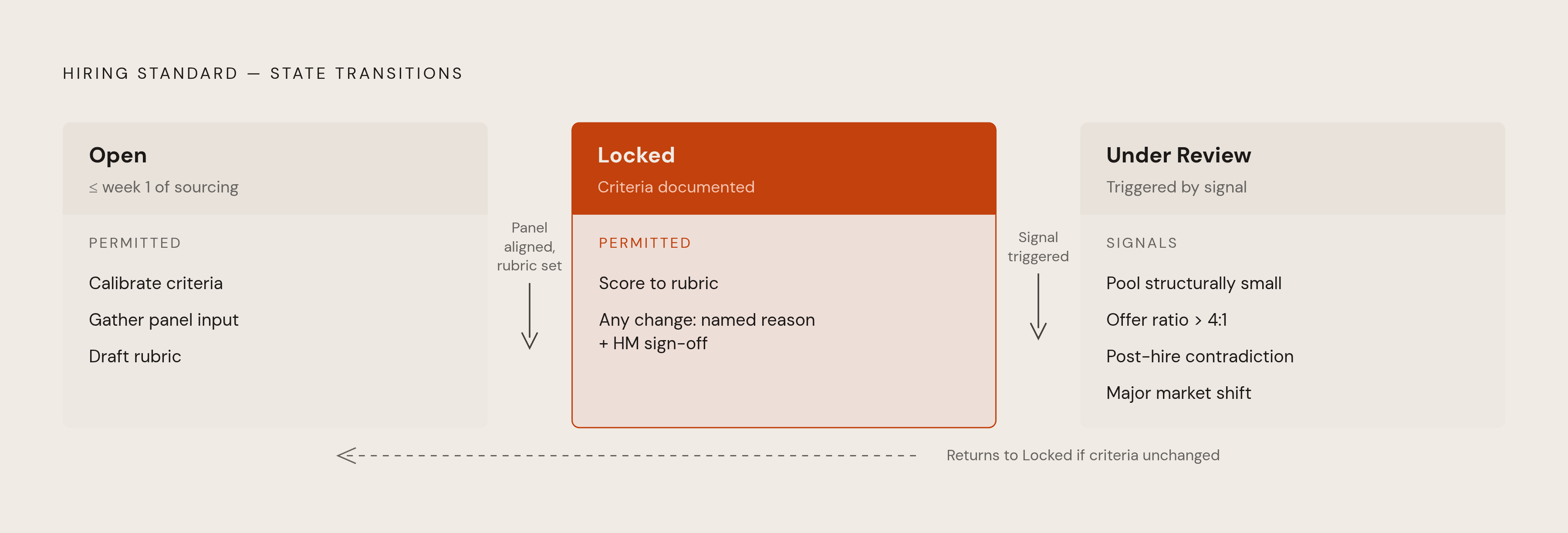
A standard exists in one of three states at any given moment, and each state calls for a different kind of discipline.
Open, meaning pre-calibration, is appropriate only before the panel has aligned on criteria and evidence together. It should not persist past the first week of sourcing. Locked means the search is active: criteria and evidence thresholds are documented, panel-aligned, and scored on a rubric; any change from here requires a named reason and hiring manager sign-off. Under review means a specific triggering signal, market data, a repeated interview pattern, post-hire performance results, has prompted a deliberate, formal recalibration. The standard is being examined on purpose in this state. It's being examined on purpose.
What actually justifies moving from Locked into Under Review? A few concrete triggers: the addressable pool analysis comes back structurally small even after titles and geography have been adjusted, the interview-to-offer ratio stays above 4:1 after sourcing has already been corrected, post-hire performance across multiple hires shows the standard predicted the wrong outcomes, or a major market event materially shrinks the accessible pool.
What doesn't justify unlocking anything: timeline pressure by itself, one strong candidate missing a single criterion, a hiring manager's enthusiasm for one specific person, or a recruiter's sense that "the market has changed" with no data behind it.
When a change genuinely is warranted, it should be explicit. Change the criterion or the evidence threshold directly, write down the reasoning, get the hiring manager's approval, and re-calibrate the whole panel before the search continues. Not a quiet mid-search tweak nobody notices until the offer stage.
The human role here doesn't go away, and it shouldn't. AI can surface patterns across interview feedback, flag when scores are drifting away from the rubric, and stress-test a standard against real market data. But the actual decision, what "exceptional" means for this role, belongs to the humans who own the hire. An AI system that makes every standard change visible and requires human approval is the mechanism that keeps the whole framework honest, especially across a long search or several concurrent ones. It's the mechanism that keeps the whole framework honest, especially across a long search or several concurrent ones.
What good calibration discipline looks like across the search lifecycle
Before the search opens: a panel calibration session, sample-candidate scoring, full rubric alignment. The standard gets locked with explicit evidence thresholds attached to every criterion.
Weeks two and three: first sourcing results function as market intelligence, not as a verdict. If the pool looks thin, run the addressable pool calculation before questioning the standard itself.
Mid-search: check the interview-to-offer ratio. Running above 4:1? That signals too many borderline candidates are reaching final rounds, per seekout.com, and the underlying cause is worth diagnosing before moving forward, because those three problems have three different fixes, and treating them as one problem wastes time.
Post-hire, at 90 days and again at 12 months: a Quality-of-Hire score, weighting 90-day manager ratings, early performance, and 12-month retention together, closes the loop back into the standard for the next search.
What separates the top-performing hiring teams, based on a Starred benchmark report, is discipline: defining what "great" looks like before the role even opens, aligning deeply with hiring managers on that definition, and using AI deliberately with clear human ownership over the calibration. It's discipline: defining what "great" looks like before the role even opens, aligning deeply with hiring managers on that definition, and using AI deliberately with clear human ownership over the calls that matter.
The teams still holding their hiring bar through 2026 won't be the ones with the strictest standards, or the loosest ones. They'll be the ones who can say, at any point in a search, exactly why their standard is what it is, and exactly what evidence would be enough to change it.